
Independent review. School Clinic has no affiliation with any company named here and received no payment, sponsorship, free product, or endorsement. School Clinic is a proposal, not a clinic. This article is part of our CSC (Continuity of School Clinic) series and is general education only. It is not medical, legal, IT-security, or purchasing advice. Prices are as reported on the dates noted and change often.
In our companion guide to backup laptops, we explained why a protected, solar-ready laptop is the right MI tool for an emergency. We also noted that on-site servers still have a place in everyday operations. This review looks at that side of the question: if a college or university health service wanted to run its own language models, on its own hardware, with no student data leaving the building, what could it buy in 2026?
Why a clinic might want its own MI server
- Data control. Health records and notes stay on equipment the institution owns, rather than being sent to a cloud provider.
- Shared use. One machine can serve a whole team of clinicians and staff, instead of one laptop per person.
- Predictable cost. A one-time purchase instead of per-user subscription fees, although power, maintenance, and IT time still cost money.
- Larger models. More memory means larger, more capable open-weight models and longer documents.
The 2026 options at a glance
| Option | Memory for models | Reported price | Size and noise | Best fit |
|---|---|---|---|---|
| AMD Ryzen AI Max+ mini PC (for example, Framework Desktop) Entry point | 128 GB (up to 96 GB for graphics); a 192 GB version announced in 2026 | About $3,449 for 128 GB; $6,799 for 192 GB (September 2026) | 4.5-liter mini PC; quiet | A small clinic team piloting local MI |
| NVIDIA DGX Spark (and partner GB10 systems) | 128 GB unified memory | $4,699 list price (after a February 2026 increase) | Palm-sized, about 1.1 liters | Small teams that want NVIDIA’s software ecosystem |
| Apple Mac Studio (M5 Max or M5 Ultra) Most memory per dollar | M5 Max up to 128 GB; M5 Ultra up to 512 GB | From $2,499 (M5 Max) and $5,499 (M5 Ultra); 512 GB expected above $10,000 | Compact desktop; quiet | Running very large models in an office setting |
| Workstation tower with RTX PRO 6000 Blackwell (built by Dell, HP, Lenovo, Puget, Lambda, Bizon, and others) | 96 GB of graphics memory per card; one or more cards | The card alone was reported at $8,500+ in early 2026, with later reports of sharp increases; full systems cost more | Full tower; up to 600 W per card, audible under load | A larger health service with campus IT support |
| NVIDIA DGX Station / Dell Pro Max with GB300 | About 748 GB total (252 GB GPU plus 496 GB system) | Listed from about $95,000 (August 2026) | Large liquid-cooled tower; 1,600 W power supply | Research-scale work; overkill for most clinics |
| Rack servers (Dell, HPE, Lenovo, Supermicro) | Several GPUs per server | Typically quoted per project; often well into six figures | Loud; needs a data center with cooling | University-wide platforms run by central IT |
Product notes
AMD Ryzen AI Max+ mini PCs
The same AMD chip family found in high-end laptops also powers small desktops. The Framework Desktop offers 128 GB of memory, up to 96 GB of which can be assigned to graphics, in a 4.5-liter case, and Framework says it can run Llama 3.3 70B. In September 2026, Phoronix reported the 128 GB model at about $3,449 and a new 192 GB version at $6,799. For a clinic, this is the most affordable way to try a shared local model.
NVIDIA DGX Spark
NVIDIA’s DGX Spark packs its GB10 chip and 128 GB of unified memory into a box about six inches square. Tom’s Hardware found that its 128 GB “makes it easy to run most local AI models.” Notebookcheck reported a $700 price increase in February 2026, to a $4,699 list price. Partner versions of the same design are sold by other computer makers. It suits teams that want NVIDIA’s widely used AI software tools in a small, office-friendly box.
Apple Mac Studio
Apple’s 2026 Mac Studio offers up to 128 GB of memory with the M5 Max chip and up to 512 GB with the M5 Ultra. MacRumors lists US prices starting at $2,499 and $5,499, with the 512 GB model expected above $10,000. That much memory can hold very large open-weight models in a quiet desktop that fits on a shelf. The trade-off is that many hospital and campus IT departments are built around Windows and Linux, so support should be confirmed first.
Workstations with RTX PRO 6000 Blackwell
NVIDIA’s RTX PRO 6000 Blackwell has 96 GB of graphics memory with error correction and draws up to 600 W. Workstation builders such as Dell, HP, Lenovo, Puget Systems, Lambda, and Bizon offer towers with one or more of these cards. They are the fastest option for serving several users at once, but they are expensive, power-hungry, and best managed by campus IT.
DGX Station and rack servers
At the top end, the GB300-based DGX Station was listed from about $95,000 in August 2026, with roughly 748 GB of memory and a 1,600 W power supply. Dell sells a similar Pro Max with GB300. Multi-GPU rack servers from Dell, HPE, Lenovo, and Supermicro sit in data centers. These make sense for a university research platform, not a single health center.
Which option fits which clinic?
| Setting | Realistic starting point | Why |
|---|---|---|
| K-12 school nurse office | No server; work through the district | Student health records often fall under FERPA and district policy; any MI tool should be chosen and managed at the district level |
| Small college health center Good first step | Ryzen AI Max+ mini PC, DGX Spark, or Mac Studio | Low cost, quiet, office-friendly, enough memory for strong mid-size models |
| Large university health service | RTX PRO 6000 workstation or a hosted machine in the campus data center | Serves many users at once; campus IT provides security, backups, and monitoring |
| University-wide or research use | DGX Station or rack servers run by central IT | Large scale, high cost, needs data center power and cooling |
Models and software
The open-weight models covered in our laptop guide, including Gemma, Qwen, gpt-oss, Mistral, Llama, and Phi, run on all of these machines. More memory allows larger models: 128 GB comfortably holds models in the 70B to 120B range in compressed form, while 512 GB or more can hold some of the largest open-weight models available. Tools such as Ollama, LM Studio, and llama.cpp work well for small teams, while server software such as vLLM is designed for many users at once.
On-premises does not mean automatically compliant
- HIPAA and FERPA still apply. Keeping data in-house avoids sending it to a cloud provider, but the institution must still apply HIPAA Security Rule safeguards, FERPA where it governs records, and state privacy law.
- Security basics. Encryption, access controls, audit logs, patching, backups, and physical security are all the institution’s responsibility.
- Human review. A licensed professional reviews every output. The model makes no clinical decisions.
- Licences. Check each model’s licence for permitted uses.
- Adults only. Any use involving students under 18 must be by licensed adult staff under school and parental consent policies.
Servers for every day, laptops for emergencies
A server room is a single point of failure when the grid goes down, and most of these machines depend on wall power, cooling, and a working network. That is why the CSC series recommends pairing any on-site server with a protected backup laptop that can run a smaller model on battery or solar power. The server handles everyday work; the laptop keeps essential help available during an emergency, as described in CSC Part 1.
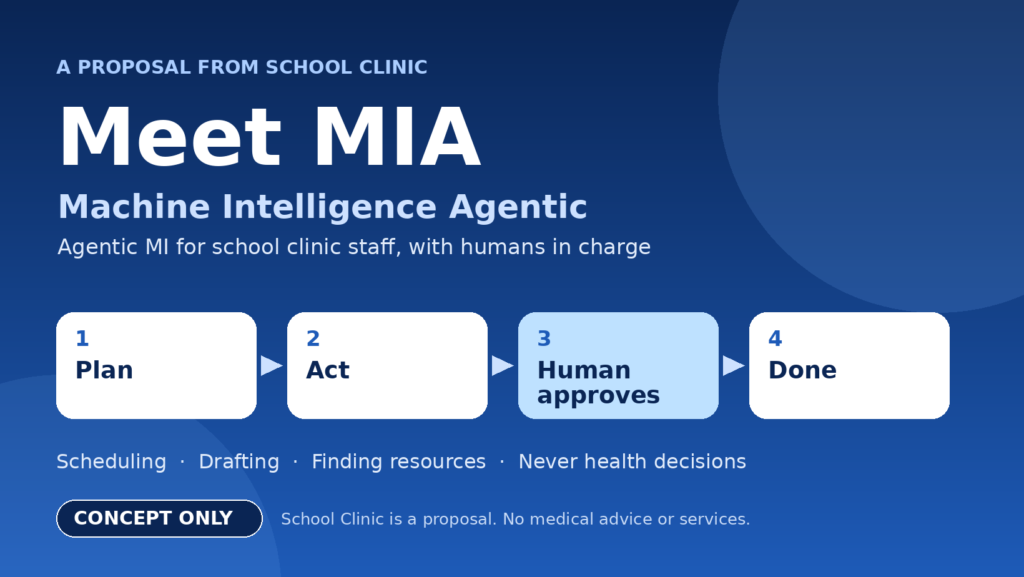
Both fit School Clinic’s MIA (Machine Intelligence Agentic) vision: MI that drafts, summarizes, and organizes, with a human approving every action. As of 2026, School Clinic’s MI vision is limited to general health and wellness education and administrative support, supervised by licensed humans, with greater autonomy only if and when laws allow.
Would your health service run its own MI server? We invite college students, parents, school nurses, doctors, social workers, educators, researchers, policymakers, pharmacists, dietitians, physical therapists, physician assistants, IT professionals, emergency managers, and members of the public (adults 18 and over) to share your views through our Get Involved page.
Sources
- Framework, Framework Desktop specifications; Phoronix, “Framework Desktop With AMD Ryzen AI Max+ PRO 495 Starts Out At $6799 USD” (September 30, 2026)
- Tom’s Hardware, Nvidia DGX Spark review (January 2026); Notebookcheck, DGX Spark price increase (February 28, 2026)
- Apple, Mac Studio with M5 Max and M5 Ultra announcement (August 2026); MacRumors, 2025 vs. 2026 Mac Studio buyer’s guide (August 27, 2026)
- NVIDIA, RTX PRO 6000 Blackwell Workstation Edition (accessed November 29, 2026)
- Tom’s Hardware, GB300 DGX Station listed for nearly $100,000 (August 2026); Notebookcheck, Dell Pro Max with GB300 (March 16, 2026)
- School Clinic, backup laptop guide and CSC Part 1
AMD, Ryzen, Framework, NVIDIA, DGX, RTX, Apple, Mac Studio, Dell, HP, HPE, Lenovo, Supermicro, Puget Systems, Lambda, Bizon, and the model and software names mentioned are trademarks of their owners and are used here only to identify products. Prices and specifications change often; confirm details with each maker before purchasing. We did not test these products ourselves.
Disclaimer: School Clinic is a proposal and offers no medical advice or services whatsoever. This article is general education and product commentary only. It is not medical, legal, IT-security, or purchasing advice, and it is not an operational plan for any institution. Any use of MI tools with health information must follow applicable law and institutional policy, with licensed human review. School Clinic does not communicate with anyone under 18. In an emergency, call 911. In a mental health crisis, call or text 988.