

Most of the machine intelligence (MI) people know today answers questions. You type, it replies, and you do the rest. A new kind of MI goes one step further. It can take a goal, break it into steps, and carry those steps out: check a calendar, draft a letter, search a directory, and come back with the work ready for a person to review. This is often called agentic MI, because it acts as an agent on someone’s behalf. In this post, we imagine what agentic MI could do for the people who run school clinics, where the lines must be drawn, and we make a small proposal: let’s call it MIA, for Machine Intelligence Agentic.
Reminder: School Clinic is a proposal. The clinic does not yet exist, and School Clinic offers no medical advice or services whatsoever. Everything below is a vision for discussion, not a product or a service.
From answering to acting
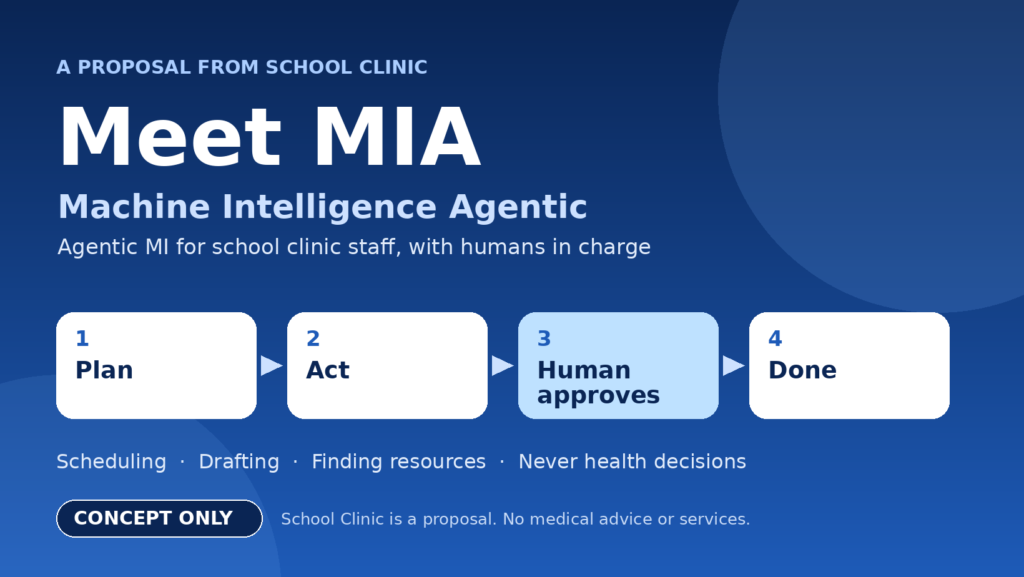
Here is the difference in one example. Ask a conversational MI, “When is Dr. Lee free next week?” and it might tell you, if it can see her calendar. Ask an agentic MI, “Set up the spring vision screening day with Dr. Lee and the front office,” and it could check three calendars, find a time that works, draft the announcement, reserve the room, and put it all in front of the clinic manager with one question: Approve?
That last step matters most. In School Clinic’s vision, an agentic MI never finishes a meaningful task on its own. It plans, it prepares, and then it stops and waits for a human to say yes.
What MIA could do for school clinic staff
Agentic MI is built for multi-step chores, the kind that eat a nurse’s or a clinic coordinator’s afternoon. A few examples:
- Scheduling. Find open times across staff calendars, book rooms, send confirmations, move appointments when someone cancels, and keep a waitlist, all queued for staff approval. At the college level, this builds on our scheduling beta proposal for adult students.
- Drafting. Prepare first drafts of routine letters, permission forms, event flyers, staff memos, and reports from notes the staff already wrote. A human edits and signs every one.
- Finding resources. Search approved directories for community programs, food pantries, transportation help, or language services, and return a short list with sources for staff to check.
- Coordinating. Keep shared task lists in sync between nurses, counselors, social workers, and front-office staff, so nothing slips between teams.
- Tracking deadlines. Remind staff about form renewals, trainings, license renewals, supply orders, and reports due to the district or campus.
- Keeping things tidy. Organize files, flag missing fields on forms, spot duplicate records, and keep the resource list up to date.
If this sounds familiar, it should. Our post 101 Ways MI Social Workers Could Be the Best Personal Assistant a Social Worker Could Ever Want describes the same idea for social workers. Agentic MI is what would make many of those 101 ideas possible, and MIA is the name we propose for that kind of helper across the whole school clinic team.
One important note for K-12 schools: in this vision, MIA works for adult staff only. It would not message, chat with, or contact students in elementary, middle, or high school. It helps the grown-ups do the paperwork so they have more time for the children in their care.
Six guardrails for any MIA in a school clinic
- Humans stay in charge. MIA proposes; people decide. Anything that leaves the building, changes a record, or affects a person waits for a named staff member to approve it.
- No health decisions, ever. MIA never diagnoses, triages, recommends treatment, decides who is seen first, or gives medical advice. Those are jobs for licensed professionals.
- Privacy by design. MIA sees only the minimum information a task needs, and it must follow every applicable privacy and security law, such as FERPA, HIPAA, and California law. Our post on the proposed school.doctor beta login portal explains the kind of protections we have in mind.
- Stop and hand off. If a task touches an emergency, a safety concern, or anything outside its narrow job, MIA stops and alerts a human right away. It never handles a crisis by itself.
- Everything is logged. Every step MIA takes is recorded in plain language, so staff and supervisors can see what it did, why, and who approved it. Mistakes are reported openly, not hidden. (MI can be confidently wrong, as we explain in When MI Makes Things Up.)
- Support, never replacement. Time saved goes back to people. MIA should never be used to cut a nurse’s, doctor’s, social worker’s, or clerk’s job, hours, or pay, the same principle behind our first legislative proposal.
What MIA would never do
Clear limits build trust, so here they are in plain words. In School Clinic’s vision, MIA would never:
- diagnose, triage, or give medical, mental health, or legal advice;
- decide who gets care, when, or what kind;
- prescribe, order, or change medications, tests, or treatments;
- contact students under 18;
- send, sign, or submit anything without a human’s approval;
- share private information beyond what a task strictly needs; or
- pretend to be a human.
Our proposal: call it MIA
On this site, we say “MI,” for machine intelligence, where others say “AI.” As agentic tools arrive, they need a name too. We propose MIA, short for Machine Intelligence Agentic, and here is why:
- It fits. MIA builds on “MI,” so readers can tell at a glance that it belongs to the same family.
- It is clear. The “A” for “agentic” separates an MI that acts from an MI that only talks, such as the conversational MI avatars we have written about.
- It is friendly. MIA is easy to say and easy to remember, for staff, families, and lawmakers alike.
- It is honest about what it is. The name says “machine” right in it, a reminder that MIA is a tool, not a person.
Yes, we know “MIA” also means “missing in action.” We think that is a useful reminder: an agentic MI should never go missing. Every action should be visible, logged, and accountable to a human.
To be clear, MIA is a proposed working name for a kind of tool, not a product, a brand, or a service School Clinic offers. Before any formal use, we would check that it does not conflict with existing names.
Tell us what you think
Do you like the name MIA? Would you suggest a different one? Which multi-step chores in your school clinic would you hand to an agentic assistant first, and which should no machine ever touch? We especially want to hear from school nurses, clinic managers, front-office staff, and campus health center teams.
We invite college students, parents, school nurses, doctors, social workers, physician assistants (PAs), pharmacists, dietitians, physical therapists, educators, researchers, policymakers, and members of the public to participate.
Get involved or email mail@school.clinic. School Clinic does not communicate with anyone under 18.
School Clinic is a proposal and offers no medical advice or services whatsoever. This post describes a possible future for discussion only. MIA is a proposed name, not a product or service. The featured image is a concept image only. School Clinic does not communicate with anyone under 18. In an emergency, call 911. In a mental health crisis, call or text 988.