
Tag: MIA

  • LLM Servers for School Clinics: A 2026 Product Review

    LLM Servers for School Clinics: A 2026 Product Review

    Independent review. School Clinic has no affiliation with any company named here and received no payment, sponsorship, free product, or endorsement. School Clinic is a proposal, not a clinic. This article is part of our CSC (Continuity of School Clinic) series and is general education only. It is not medical, legal, IT-security, or purchasing advice. Prices are as reported on the dates noted and change often.

    In our companion guide to backup laptops, we explained why a protected, solar-ready laptop is the right MI tool for an emergency. We also noted that on-site servers still have a place in everyday operations. This review looks at that side of the question: if a college or university health service wanted to run its own language models, on its own hardware, with no student data leaving the building, what could it buy in 2026?

    Why a clinic might want its own MI server

    • Data control. Health records and notes stay on equipment the institution owns, rather than being sent to a cloud provider.
    • Shared use. One machine can serve a whole team of clinicians and staff, instead of one laptop per person.
    • Predictable cost. A one-time purchase instead of per-user subscription fees, although power, maintenance, and IT time still cost money.
    • Larger models. More memory means larger, more capable open-weight models and longer documents.

    The 2026 options at a glance

    OptionMemory for modelsReported priceSize and noiseBest fit
    AMD Ryzen AI Max+ mini PC (for example, Framework Desktop) Entry point128 GB (up to 96 GB for graphics); a 192 GB version announced in 2026About $3,449 for 128 GB; $6,799 for 192 GB (September 2026)4.5-liter mini PC; quietA small clinic team piloting local MI
    NVIDIA DGX Spark (and partner GB10 systems)128 GB unified memory$4,699 list price (after a February 2026 increase)Palm-sized, about 1.1 litersSmall teams that want NVIDIA’s software ecosystem
    Apple Mac Studio (M5 Max or M5 Ultra) Most memory per dollarM5 Max up to 128 GB; M5 Ultra up to 512 GBFrom $2,499 (M5 Max) and $5,499 (M5 Ultra); 512 GB expected above $10,000Compact desktop; quietRunning very large models in an office setting
    Workstation tower with RTX PRO 6000 Blackwell (built by Dell, HP, Lenovo, Puget, Lambda, Bizon, and others)96 GB of graphics memory per card; one or more cardsThe card alone was reported at $8,500+ in early 2026, with later reports of sharp increases; full systems cost moreFull tower; up to 600 W per card, audible under loadA larger health service with campus IT support
    NVIDIA DGX Station / Dell Pro Max with GB300About 748 GB total (252 GB GPU plus 496 GB system)Listed from about $95,000 (August 2026)Large liquid-cooled tower; 1,600 W power supplyResearch-scale work; overkill for most clinics
    Rack servers (Dell, HPE, Lenovo, Supermicro)Several GPUs per serverTypically quoted per project; often well into six figuresLoud; needs a data center with coolingUniversity-wide platforms run by central IT
    On-premises MI hardware options in 2026, based on manufacturer pages and news reports from February to November 2026. Prices are as reported on those dates and are not quotes. This is not an endorsement or a buying recommendation.

    Product notes

    AMD Ryzen AI Max+ mini PCs

    The same AMD chip family found in high-end laptops also powers small desktops. The Framework Desktop offers 128 GB of memory, up to 96 GB of which can be assigned to graphics, in a 4.5-liter case, and Framework says it can run Llama 3.3 70B. In September 2026, Phoronix reported the 128 GB model at about $3,449 and a new 192 GB version at $6,799. For a clinic, this is the most affordable way to try a shared local model.

    NVIDIA DGX Spark

    NVIDIA’s DGX Spark packs its GB10 chip and 128 GB of unified memory into a box about six inches square. Tom’s Hardware found that its 128 GB “makes it easy to run most local AI models.” Notebookcheck reported a $700 price increase in February 2026, to a $4,699 list price. Partner versions of the same design are sold by other computer makers. It suits teams that want NVIDIA’s widely used AI software tools in a small, office-friendly box.

    Apple Mac Studio

    Apple’s 2026 Mac Studio offers up to 128 GB of memory with the M5 Max chip and up to 512 GB with the M5 Ultra. MacRumors lists US prices starting at $2,499 and $5,499, with the 512 GB model expected above $10,000. That much memory can hold very large open-weight models in a quiet desktop that fits on a shelf. The trade-off is that many hospital and campus IT departments are built around Windows and Linux, so support should be confirmed first.

    Workstations with RTX PRO 6000 Blackwell

    NVIDIA’s RTX PRO 6000 Blackwell has 96 GB of graphics memory with error correction and draws up to 600 W. Workstation builders such as Dell, HP, Lenovo, Puget Systems, Lambda, and Bizon offer towers with one or more of these cards. They are the fastest option for serving several users at once, but they are expensive, power-hungry, and best managed by campus IT.

    DGX Station and rack servers

    At the top end, the GB300-based DGX Station was listed from about $95,000 in August 2026, with roughly 748 GB of memory and a 1,600 W power supply. Dell sells a similar Pro Max with GB300. Multi-GPU rack servers from Dell, HPE, Lenovo, and Supermicro sit in data centers. These make sense for a university research platform, not a single health center.

    Which option fits which clinic?

    SettingRealistic starting pointWhy
    K-12 school nurse officeNo server; work through the districtStudent health records often fall under FERPA and district policy; any MI tool should be chosen and managed at the district level
    Small college health center Good first stepRyzen AI Max+ mini PC, DGX Spark, or Mac StudioLow cost, quiet, office-friendly, enough memory for strong mid-size models
    Large university health serviceRTX PRO 6000 workstation or a hosted machine in the campus data centerServes many users at once; campus IT provides security, backups, and monitoring
    University-wide or research useDGX Station or rack servers run by central ITLarge scale, high cost, needs data center power and cooling
    A general guide only. Every institution should decide with its IT, privacy, legal, and clinical leaders.

    Models and software

    The open-weight models covered in our laptop guide, including Gemma, Qwen, gpt-oss, Mistral, Llama, and Phi, run on all of these machines. More memory allows larger models: 128 GB comfortably holds models in the 70B to 120B range in compressed form, while 512 GB or more can hold some of the largest open-weight models available. Tools such as Ollama, LM Studio, and llama.cpp work well for small teams, while server software such as vLLM is designed for many users at once.

    On-premises does not mean automatically compliant

    • HIPAA and FERPA still apply. Keeping data in-house avoids sending it to a cloud provider, but the institution must still apply HIPAA Security Rule safeguards, FERPA where it governs records, and state privacy law.
    • Security basics. Encryption, access controls, audit logs, patching, backups, and physical security are all the institution’s responsibility.
    • Human review. A licensed professional reviews every output. The model makes no clinical decisions.
    • Licences. Check each model’s licence for permitted uses.
    • Adults only. Any use involving students under 18 must be by licensed adult staff under school and parental consent policies.

    Servers for every day, laptops for emergencies

    A server room is a single point of failure when the grid goes down, and most of these machines depend on wall power, cooling, and a working network. That is why the CSC series recommends pairing any on-site server with a protected backup laptop that can run a smaller model on battery or solar power. The server handles everyday work; the laptop keeps essential help available during an emergency, as described in CSC Part 1.

    Both fit School Clinic’s MIA (Machine Intelligence Agentic) vision: MI that drafts, summarizes, and organizes, with a human approving every action. As of 2026, School Clinic’s MI vision is limited to general health and wellness education and administrative support, supervised by licensed humans, with greater autonomy only if and when laws allow.

    Would your health service run its own MI server? We invite college students, parents, school nurses, doctors, social workers, educators, researchers, policymakers, pharmacists, dietitians, physical therapists, physician assistants, IT professionals, emergency managers, and members of the public (adults 18 and over) to share your views through our Get Involved page.

    When a campus experiences a disaster, its healthcare services must be prepared to continue operating. Preparedness today helps ensure continuity of care tomorrow.

    The CSC series, School Clinic

    Sources

    AMD, Ryzen, Framework, NVIDIA, DGX, RTX, Apple, Mac Studio, Dell, HP, HPE, Lenovo, Supermicro, Puget Systems, Lambda, Bizon, and the model and software names mentioned are trademarks of their owners and are used here only to identify products. Prices and specifications change often; confirm details with each maker before purchasing. We did not test these products ourselves.

    Disclaimer: School Clinic is a proposal and offers no medical advice or services whatsoever. This article is general education and product commentary only. It is not medical, legal, IT-security, or purchasing advice, and it is not an operational plan for any institution. Any use of MI tools with health information must follow applicable law and institutional policy, with licensed human review. School Clinic does not communicate with anyone under 18. In an emergency, call 911. In a mental health crisis, call or text 988.

  • CSC Companion: Choosing a Backup Laptop That Can Run Local MI for the Campus Clinic

    CSC Companion: Choosing a Backup Laptop That Can Run Local MI for the Campus Clinic

    About the CSC series. CSC, short for Continuity of School Clinic, is School Clinic’s ongoing educational series on how school and campus health services can prepare for, respond to, and keep essential care going during emergencies. This companion post expands on one idea from CSC Part 1: When the Grid Goes Down, Can the Campus Clinic Keep Going? School Clinic is a proposal, not a clinic. This post is general education only. It is not medical, legal, IT-security, or purchasing advice, and School Clinic has no affiliation with, and receives nothing from, any company or model named here.

    In CSC Part 1, we suggested that a campus clinic keep a protected backup device: a charged laptop and an encrypted drive, stored in a Faraday bag and paired with a portable solar battery backup. We also suggested considering a laptop powerful enough to run a small language model locally, with no internet connection at all. This post looks at what that means in practice: which kinds of laptops can do it, which open-weight models fit them, and how a clinic could use them safely during a long outage.

    Why “local” matters in an outage

    Most MI tools today run in the cloud. When the grid fails, internet and cell service can fail with it, and cloud tools disappear just when staff are most stretched. A local model runs entirely on the laptop. It needs no connection, and the data it reads never leaves the device. That makes it a natural fit for a continuity plan, and an early, offline step toward School Clinic’s MIA (Machine Intelligence Agentic) vision.

    The one spec that matters most: memory

    A language model has to fit in memory to run well. On Apple and AMD “unified memory” laptops, the processor and graphics share one large pool. On laptops with a separate NVIDIA graphics card, the model must fit in the card’s own video memory (VRAM). As a rough guide, aim for at least 32 GB of memory (64 GB or more is better) and a 1 TB or larger SSD for the models, the continuity plan, and downtime records.

    Three classes of capable laptops

    FeatureApple MacBook Pro (M5 Pro or M5 Max)AMD Ryzen AI Max+ laptops (for example, HP ZBook Ultra G1a)NVIDIA RTX 5080 or 5090 laptops
    Memory for models Key differenceUnified memory: M5 Pro up to 64 GB; M5 Max up to 128 GBUp to 128 GB unified memory; HP says up to 96 GB can be assigned to graphicsSeparate VRAM: 16 GB (RTX 5080) or 24 GB (RTX 5090), plus system RAM
    Operating systemmacOSWindows (Linux possible)Windows (Linux possible)
    Power and battery Key differenceVery efficient; Apple lists up to 22 to 24 hours of video playback on the 16-inch modelModerate power draw; HP lists 140 W chargingGraphics alone can draw 80 to 150 W, so batteries drain fast
    Largest practical modelsWith 128 GB, models of 100B+ parameters (quantized)With 128 GB, models of 70B to 120B (quantized)About 20B to 30B models fit fully in 24 GB of VRAM
    SpeedFast, especially with very long documentsModerateFastest on models that fit in VRAM
    Fit with solar backupBestGoodWeakest
    Three classes of laptops that can run local language models, based on manufacturer specifications and published reviews checked November 29, 2026. Other laptops in each class exist. This is not an endorsement or a buying recommendation.

    Apple MacBook Pro. Apple’s 2026 14-inch and 16-inch MacBook Pro models with the M5 Pro or M5 Max chip offer up to 64 GB (M5 Pro) or 128 GB (M5 Max) of unified memory. Because they deliver strong performance at low power, they pair best with a portable solar power station.

    AMD Ryzen AI Max+ laptops. The HP ZBook Ultra G1a uses AMD’s Ryzen AI Max+ PRO processors with up to 128 GB of unified memory, and HP markets it for working with LLMs “locally and offline.” Other designs, such as the ASUS ROG Flow Z13 tablet, use the same family of chips. These are a strong choice for clinics standardized on Windows.

    NVIDIA RTX laptops. According to Tom’s Hardware, the RTX 5090 laptop GPU has 24 GB of VRAM and the RTX 5080 has 16 GB, with power limits set by each laptop maker between roughly 80 and 150 W. They are the fastest option for models that fit, but in a reported head-to-head test, a 128 GB M5 Max ran a 122-billion-parameter model that a 24 GB RTX 5090 could not hold at all.

    Which local models could run on them

    “Open-weight” models can be downloaded and run on your own hardware. The field changes every few months, so treat the names below as examples as of late 2026, not a final list. Sizes assume common 4-bit “quantized” versions, which shrink a model so it fits in less memory.

    Memory availableExample open-weight modelsGood for
    16 GBGemma 4 12B, gpt-oss-20b, Qwen 3.5 9B, Ministral 3 14B, Phi familyShort drafts, summaries of single forms, quick questions about the plan
    32 GB Sweet spotQwen 3.8 27B, Gemma 4 26B or 31B, Qwen 3.6 35B-A3BMost clinic tasks: drafting, summarizing batches of forms, searching long plans
    64 GBThe 32 GB models at higher quality, with room for long documentsLonger documents and more accurate output
    96 to 128 GBgpt-oss-120b, Qwen 3.5 122B, Llama 4 Scout, Mistral Small 4The most capable offline assistance, at higher power draw
    Example open-weight models by memory size, based on published local-model guides from October and November 2026. Model names, sizes, and licences change often. Check each model’s official card and licence before use.

    Runtimes. Free tools such as Ollama, LM Studio, and llama.cpp download and run these models on macOS, Windows, and Linux, and Apple’s MLX framework is optimized for Apple chips. The key step for a continuity plan is to download the runtime and models in advance, then test them with the internet switched off. A model you cannot download during an outage is no help.

    How a clinic could use it during an outage

    • Drafting notes. Turn a clinician’s quick, typed or dictated observations into a structured draft note that the clinician then edits and signs.
    • Summarizing downtime forms. Condense stacks of paper downtime records, once typed or scanned, into summaries ready for entry into the electronic health record after power returns.
    • Searching the continuity plan. Ask plain-language questions such as “Who is our alternate vaccine storage contact?” and get the answer with the page it came from.
    • Drafting communications. Prepare first drafts of staff updates and student notices for a human to review before anything is sent.
    • Checklists and logs. Keep running shift logs, supply counts, and to-do lists in one place.

    Safeguards that come first

    • A human reviews everything. Every note, summary, or message is checked by a licensed professional before it is saved or shared. Local models make mistakes, and smaller models make more of them.
    • No clinical decisions. The model never diagnoses, triages, or recommends treatment. It assists with paperwork and information, nothing more.
    • Data stays encrypted on the device. Use full-disk encryption, strong passwords, and an encrypted external drive. Health information is handled under HIPAA, FERPA, state law, and campus IT and privacy policies, and campus IT should approve the setup.
    • Licences and testing. Check each model’s licence and test its accuracy on sample, non-real data before relying on it.
    • Power draw. Running a model uses more battery than ordinary work. Plan solar and battery capacity for it, and use smaller models when power is scarce.
    • Physical protection. Store the laptop and drive in a Faraday bag, keep them charged, and update the software and plan on a set schedule.
    • Adults only. Any use involving students under 18 must be by licensed adult staff under school and parental consent policies.

    The MIA connection

    School Clinic’s MIA vision imagines agentic MI that prepares, drafts, and organizes, while a human approves every action. A local model on a protected, solar-powered laptop is a modest, practical version of that idea: an assistant that still works when everything else is down. As of 2026, School Clinic’s MI vision is limited to general health and wellness education and administrative support, supervised by licensed humans, with greater autonomy only if and when laws allow.

    Quick checklist

    • ☐ Laptop with at least 32 GB of memory (64 GB or more preferred) and a 1 TB or larger SSD
    • ☐ Runtime and models downloaded in advance and tested offline
    • ☐ Continuity plan, contact lists, and downtime forms stored locally and encrypted
    • ☐ Campus IT and privacy approval for the setup
    • ☐ Solar power station sized for the laptop’s power draw
    • ☐ Faraday bag for storage, with a regular charging and update schedule
    • ☐ Written rule that a licensed human reviews every output

    Afterword: why laptops, not LLM servers

    Some readers may ask why CSC suggests a laptop instead of an on-site LLM server, the kind of rack-mounted machine larger organizations use to run AI models for many users at once. For a continuity plan, we chose laptops for three reasons.

    Cost. A capable laptop costs a few thousand dollars. A GPU server can cost tens of thousands of dollars or more, before adding the dedicated room, cooling, networking, and IT staff time it needs. For a campus clinic, a laptop puts offline MI within reach of an ordinary budget.

    Energy efficiency. A laptop runs on its own battery and can be recharged from a portable solar power station. A server draws far more power, often measured in kilowatts, and depends on the same generators and air conditioning that may already be stretched or failing during a grid outage. In an emergency, every watt matters.

    Portability and survivability. A laptop can be picked up and carried to an alternate care site, evacuated with staff, or stored in a Faraday bag between uses. A server room is a single point of failure: if the building floods, loses cooling, or must be closed, the server goes with it. In a disaster, the tool that survives is the one that can move.

    On-site servers still have a place. For everyday operations at a large health service, with many users and steady power, they may be the right choice; see our 2026 review of LLM servers for school clinics. But for continuity of care when the grid fails, a protected, solar-ready laptop is simpler, cheaper, and far more likely to be working when it is needed most.

    Do you work in campus health, IT, or emergency management? We invite college students, parents, school nurses, doctors, social workers, educators, researchers, policymakers, pharmacists, dietitians, physical therapists, physician assistants, emergency managers, and members of the public (adults 18 and over) to share your views through our Get Involved page.

    When a campus experiences a disaster, its healthcare services must be prepared to continue operating. Preparedness today helps ensure continuity of care tomorrow.

    The CSC series, School Clinic

    Sources

    Apple, MacBook Pro, HP, ZBook, AMD, Ryzen, ASUS, ROG, NVIDIA, RTX, and the model and software names mentioned are trademarks of their owners and are used here only to identify products. Specifications, prices, and model availability change often; confirm details with each maker before purchasing. Benchmark figures are from third-party tests we did not reproduce.

    Disclaimer: School Clinic is a proposal and offers no medical advice or services whatsoever. This article is general education only. It is not medical, legal, IT-security, or purchasing advice, and it is not an operational plan for any institution. Any use of MI tools with health information must follow applicable law and institutional policy, with licensed human review. School Clinic does not communicate with anyone under 18. In an emergency, call 911. In a mental health crisis, call or text 988.

  • Microsoft Dragon Copilot vs. Heidi Health: A Side-by-Side Look for School Clinics

    Microsoft Dragon Copilot vs. Heidi Health: A Side-by-Side Look for School Clinics

    Independent comparison. School Clinic has no affiliation with Microsoft or Heidi Health and received no payment, sponsorship, free account, or endorsement from either. School Clinic is a proposal, not a clinic. This article is general education only, not medical, legal, or purchasing advice.

    In our comparison of nine AI scribes, two names kept coming up: Heidi Health, the subject of our full review, and Microsoft Dragon Copilot, the scribe backed by one of the largest technology companies in the world. They take very different paths to the same goal: a clinical note written while the clinician talks with the patient. Here is how they compare, using facts we checked on November 29, 2026.

    Side by side

    FeatureMicrosoft Dragon CopilotHeidi Health
    MakerMicrosoft (formerly Nuance DAX Copilot plus Dragon Medical One)Heidi, founded 2021, based in Melbourne, Australia
    Built mainly forHealth systems and healthcare organizationsIndividual clinicians up to health systems
    How to get itThrough an organization; no self-serve plan foundSelf-serve sign-up, or team plans by quote
    Free option Key differenceNone foundFree tier; 14-day trial of Clinician plan
    Published priceNot publishedNot published in USD
    LanguagesAmbient capture in 58 languages110 languages (company figure)
    AppsMobile, web, and Windows desktopiOS and Android, web, and desktop (macOS and Windows)
    EHR connection Key differenceDeep EHR integration; DAX was first integrated into Epic in 2024EHR integrations, fuller on team plans
    NursingNursing documentation (US)Head-to-toe assessment and other nursing templates
    Beyond the notePartner app marketplace, coding suggestions, radiology (preview)Evidence answers, agents, patient recaps, forms
    TemplatesProfiles and templates migrate from Dragon Medical OneCommunity library with “hundreds” of templates
    Privacy claimsRuns on Azure (HIPAA, HITRUST, ISO 27001, SOC 2 listed); treats all data as PHIHIPAA, BAA for every covered entity, SOC 2 Type II, ISO 27001, ISO 42001
    Audio storageMobile audio deleted after upload; desktop and web do not keep itNot found on the public pages we read
    Independent trial Key differenceTested in a randomized trial (as DAX): no significant time savingNot yet tested in a published randomized trial
    ScaleMore than 100,000 clinicians dailyAbout 2.8 million patient interactions a week
    Microsoft Dragon Copilot and Heidi Health compared, based on company websites and news reports checked November 29, 2026. Rows marked “Key difference” matter most for school clinics. Company figures are not independently audited.

    Microsoft Dragon Copilot: the enterprise heavyweight

    Microsoft launched Dragon Copilot in 2025, combining DAX Copilot, the ambient scribe from its Nuance unit, with Dragon Medical One, a dictation tool many physicians have used for years. At HIMSS 2026, Microsoft said more than 100,000 clinicians use it daily. It supports ambient capture in 58 languages, with physician versions available in the US, Canada, the UK, Ireland, and several European countries. It also has a US nursing version and a radiology version in preview. Organizations can add partner apps through a marketplace.

    Its biggest strength is integration. DAX Copilot became fully integrated into the Epic EHR in January 2024, so health systems that run Epic can use it inside the record they already have. Its security documentation says Microsoft “treats all customer data as though it is PHI,” encrypts data in transit and at rest, deletes mobile audio after upload, and does not keep data on desktop and web. The certifications it lists, including HITRUST, ISO 27001, and SOC 2, are those of Microsoft Azure.

    The independent evidence is mixed. In a NEJM AI randomized trial published in December 2025, the DAX version showed no significant change in the time physicians spent on notes (about 1.7% less, which could be chance). Physicians did report better burnout and workload scores, which the authors said need confirmation.

    Heidi Health: the open-door challenger

    Heidi takes the opposite approach. Any clinician can sign up for free, try the paid Clinician plan for 14 days, and use a community library of templates made by other clinicians. Its HIPAA page says it offers a BAA to every covered entity and hosts US data in the United States. It has grown fast, raising $340 million in 2026 at a $900 million valuation, per Fierce Healthcare.

    Its main gaps are evidence and transparency. Heidi’s accuracy studies are company preprints, it has not yet been tested in a published randomized trial, and we could not find its audio retention or AI-training policies on the public pages we read.

    Which fits a school clinic?

    • A hospital-run SBHC on Epic. Dragon Copilot may already be available through the parent health system, and keeping notes inside Epic is a real advantage. Ask the health system first.
    • An independent SBHC or campus health center. Heidi is far easier to try. A free tier lets a small team test it before a formal review, as long as no real student data is used until contracts and policies are in place.
    • A K-12 school nurse. Neither tool is designed around FERPA, which often governs school nurse records. Legal review comes first. See FERPA and HIPAA, Explained Simply.
    • Privacy-first teams. Microsoft publishes more detail on how audio is handled. With Heidi, ask for retention and training policies in writing.

    Adults only. With either tool, any use involving students under 18 should be by licensed adult clinicians, under school and parental consent policies, with every note checked by a human before it is saved or shared.

    The MIA angle

    Both products are moving from scribes to agents. Microsoft is building a marketplace of partner apps around Dragon Copilot; Heidi is building a “care partner” that prepares, follows up, and drafts patient recaps for the clinician to approve. That is the direction School Clinic’s MIA (Machine Intelligence Agentic) vision anticipates, with a human approval step at the center. As of 2026, School Clinic’s MIA vision is limited to general health and wellness education, supervised by licensed humans, with greater autonomy only if and when laws allow.

    The verdict

    Dragon Copilot is the safer choice for large organizations already in the Microsoft and Epic world: deep integration, detailed security documentation, and a trial record, even if that trial showed only modest results. Heidi is the more accessible choice for small teams that want to try an AI scribe without a large contract. For most school clinics, the deciding factor will not be the software. It will be whether their privacy rules, consent policies, and legal review are ready.

    Which would you choose for your school or campus? We invite college students, parents, school nurses, doctors, social workers, educators, researchers, policymakers, pharmacists, dietitians, physical therapists, physician assistants, and members of the public (adults 18 and over) to share your views through our Get Involved page.

    Sources

    Microsoft, Dragon Copilot, Heidi, and Heidi Health are trademarks of their owners and are used here only to identify the products discussed. Security and compliance claims are as stated by each company; we did not audit them.

    Disclaimer: School Clinic is a proposal and offers no medical advice or services whatsoever. This article is general education and product commentary only, not medical, legal, or purchasing advice. School Clinic does not communicate with anyone under 18. In an emergency, call 911. In a mental health crisis, call or text 988.

  • Beyond Heidi: Comparing Nine AI Scribes Through a School Clinic Lens

    Beyond Heidi: Comparing Nine AI Scribes Through a School Clinic Lens

    Independent comparison. School Clinic has no affiliation with Heidi Health or any company named in this article, and received no payment, sponsorship, free account, or endorsement from any of them. School Clinic is a proposal, not a clinic. This article is general education only, not medical, legal, or purchasing advice.

    Our Heidi Health review and our guide to Heidi’s templates looked closely at one AI scribe. But Heidi is one of many. AI scribes, tools that listen to a clinical visit and draft the note, have become one of the busiest markets in health technology. Here we compare nine well-known competitors, using facts we checked against company websites and news sources on November 29, 2026.

    The key question for school health is simple: is the tool built for a large health system, or can a small team, such as a school-based health center (SBHC) or a campus health center, actually sign up and use it?

    The comparison at a glance

    ScribeBuilt mainly forPublished priceFree option
    Heidi Health Closest fitIndividual clinicians to health systemsNot published (USD)Free tier
    Microsoft Dragon CopilotHealth systemsNot publishedNone found
    AbridgeHealth systemsNot publishedNone found
    SukiHealth systems and tech partnersNot publishedNone found
    Ambience HealthcareLarge health systemsOutcome-based, not publishedNone found
    Nabla Closest fitHealth systems and EHR vendorsNot currently publishedNone confirmed
    Freed Closest fitIndividual clinicians and small groupsFrom $39 a month7-day trial
    DeepScribeSpecialty practices, especially oncologyNot publishedNone found
    Commure Scribe Closest fitIndividual clinicians to enterprisesPro about $59 a month, billed yearlyFree tier
    Lyrebird HealthAustralian GPs and clinicsPro $160 a month (likely AUD)Free tier
    Heidi Health and nine competitors, as published on company websites on November 29, 2026. Rows marked “Closest fit” are the most realistic options for small school and campus clinics.

    Prices and plans change often. Check each company’s website for current details.

    The enterprise giants

    Microsoft Dragon Copilot

    Dragon Copilot is Microsoft’s clinical assistant. It launched in 2025 by combining DAX Copilot (from Nuance, which Microsoft owns) with Dragon Medical One dictation. At HIMSS 2026, Microsoft said it supports ambient capture in 58 languages, has nursing and radiology features, and is used daily by more than 100,000 clinicians. In the NEJM AI randomized trial from December 2025, the DAX version showed no significant change in time spent on notes, though physicians reported better burnout and workload scores. School fit: mainly for large health systems. An SBHC run by a hospital might get access through its parent organization.

    Abridge

    Abridge, founded in 2018, is used by about 300 health systems, according to Fierce Healthcare. It is known for deep Epic integration and covers 55 specialties and 28 languages, per Becker’s, which reported a $5.3 billion valuation in 2025. Its product page says it is HIPAA compliant with US cloud storage. School fit: enterprise only; most relevant to academic medical centers that run campus or school health programs.

    Suki

    Suki works with more than 250 organizations and is built into other companies’ software through more than 30 technology partners. Its website lists integrations with Epic, Cerner, athenahealth, and Meditech, support for 80+ languages, and HIPAA and SOC 2 claims. In 2026 it added a clinical question feature using UpToDate, and it raised a $90 million Series E. Pricing is per user per month, by quote. School fit: possible for SBHCs whose EHR already partners with Suki.

    Ambience Healthcare

    Ambience serves large systems such as Cleveland Clinic and covers 200+ specialties, with a strong focus on medical coding. In August 2026 it introduced outcome-based pricing, tying fees to measured results rather than seats. Becker’s reported a $1.25 billion valuation in 2025. School fit: low for schools today; its coding focus matters most to billing-heavy hospital clinics.

    The closest fits for school clinics

    Nabla

    Nabla, based in Paris with all its revenue from the US, has the strongest independent evidence of any scribe here. In the NEJM AI trial of 238 physicians at UCLA, Nabla cut time spent on notes by 9.5%, the only significant time saving in the study. Both tested scribes also made occasional clinically significant errors. Its website lists Epic, Oracle, athenahealth, NextGen, and Greenway integrations; web, iOS, Android, and Chrome apps; and HIPAA, SOC 2 Type 2, and ISO 27001 claims. Nabla says it does not store audio by default and does not use patient data to train its models, which are exactly the answers schools should want. Its customers include Children’s Hospital Los Angeles. STAT reported a new CEO in July 2026. Public pricing is not currently posted. School fit: strong for SBHCs and campus clinics, especially those with a pediatric partner, if pricing works for a small team.

    Freed

    Freed is built for individual clinicians and small groups, and it is one of the few that publishes prices. Its pricing page shows plans starting at $39 a month, a 7-day free trial with no credit card, specialty templates and a template builder, and one-click “push” into browser-based EHRs. Freed claims HIPAA and SOC 2 compliance and says audio is deleted after processing. Note that its BAA is listed with the Groups plan, which uses custom pricing. Freed raised a $30 million Series A led by Sequoia in 2025. School fit: strong for small campus clinics and SBHCs that want simple sign-up and clear pricing. Any team handling health records would need the BAA-backed group plan.

    Commure Scribe

    Commure, backed by General Catalyst, bought Augmedix for $139 million in 2024, so Augmedix is no longer a separate brand. Commure sells enterprise ambient AI and a self-serve Commure Scribe that claims 75,000+ clinicians, 60+ languages, mobile apps, and integrations with athenahealth, eClinicalWorks, SimplePractice, WebPT, and others. Its pricing page lists a free ScribeCore tier and ScribePro at $708 a year (about $59 a month). School fit: good for small teams; its SimplePractice and WebPT links may suit campus counselors and physical therapists.

    The specialists

    DeepScribe

    DeepScribe now focuses on specialty care, especially oncology, and in 2026 partnered with Flatiron Health. It shows HIPAA and SOC 2 badges. School fit: low; it is aimed at cancer and specialty practices.

    Lyrebird Health

    Lyrebird, like Heidi, is Australian, and it is built mainly for Australian general practice. It raised $12 million in 2025. Its pricing page shows a free tier and a Pro plan at $160 a month. Because that page quotes GST, those prices are most likely in Australian dollars. It highlights Australian data hosting and privacy principles, and we found no HIPAA claim. School fit: not yet suited to US schools.

    What this means for school clinics

    • Most scribes are built for hospitals. Six of the nine do not publish prices and sell mainly to large systems. Schools may need to work through a health system partner.
    • The small-team options are Heidi, Freed, Commure Scribe, and Nabla. These are the most realistic starting points for an SBHC or campus clinic.
    • None is built for FERPA. Every company here talks about HIPAA. None that we saw addresses FERPA, which often governs K-12 school nurse and campus health records. See FERPA and HIPAA, Explained Simply.
    • Ask about audio and training. Nabla and Freed state clear policies on audio storage, and Nabla on model training. Ask every vendor the same questions in writing.
    • Evidence is still thin. Only Nabla and DAX have been tested in a published randomized trial, and the savings were modest. Every note still needs a human to check it.
    • Adults only. Any use involving students under 18 should be by licensed adult clinicians, with school and parental consent policies in place.

    The MIA connection

    Across the market, scribes are becoming agents: Dragon Copilot has a partner marketplace, Ambience has an agent platform, and Heidi has its “care partner.” That is the shift School Clinic’s MIA (Machine Intelligence Agentic) vision anticipates. The best of these tools keep a human approval step before anything reaches a patient. As of 2026, School Clinic’s MIA vision is limited to general health and wellness education, supervised by licensed humans, with greater autonomy only if and when laws allow.

    Which approach would work best in your school or campus? We invite college students, parents, school nurses, doctors, social workers, educators, researchers, policymakers, pharmacists, dietitians, physical therapists, physician assistants, and members of the public (adults 18 and over) to share your views through our Get Involved page.

    Sources

    All product names are trademarks of their owners and are used here only to identify the products discussed. Security and compliance claims are as stated by each company; we did not audit them.

    Disclaimer: School Clinic is a proposal and offers no medical advice or services whatsoever. This article is general education and product commentary only, not medical, legal, or purchasing advice. School Clinic does not communicate with anyone under 18. In an emergency, call 911. In a mental health crisis, call or text 988.

  • Inside Heidi’s Template Library: A Guide for School Clinics

    Inside Heidi’s Template Library: A Guide for School Clinics

    Independent guide. School Clinic has no affiliation with Heidi Health and received no payment, sponsorship, free account, or endorsement. School Clinic is a proposal, not a clinic. This article is general education only, not medical, legal, or purchasing advice.

    In our in-depth Heidi Health review, one feature stood out as our favorite: templates. An AI scribe is only as useful as the note it produces, and templates decide what that note looks like. A dietitian, a counselor, and a nurse practitioner all document differently. Templates let each of them get a note in the shape their profession expects.

    This follow-up takes a closer look at Heidi’s Template Community, as it appeared on November 29, 2026. We explain how it works, group the templates by type, briefly describe the ones most relevant to school health, and point out what we did not find.

    How the Template Community works

    Heidi describes the library as “hundreds of professionally designed medical templates, customized for your specialty and location.” It runs to about 20 pages of template cards and can be filtered by specialty and category. Heidi does not publish an exact count.

    • Who makes them. Each template shows a “Created by” name and a specialty. Some are made by the Heidi Team; many appear to be shared by individual clinicians.
    • Notes and forms. Each template is labeled as a Note (a visit write-up) or a Form (a structured document, such as an assessment or a letter).
    • Usage counts. Each template shows how many times it has been used, which gives a rough sense of how popular it is.
    • Using one. Heidi’s three steps are “Download the template,” “Customize to your needs,” and “Deploy and share” with your team. Each template page shows an example note and the structure of the template.

    Because many templates are shared by clinicians, a school should treat them as starting points. Each one should be reviewed by the school’s own licensed staff and adapted to local policy before it is used.

    Mental health and counseling templates

    This is one of the richest parts of the library, and the most relevant to campus counseling centers and SBHCs with behavioral health staff.

    • Treatment Plan for DBT. A treatment plan for Dialectical Behaviour Therapy, with goals, objectives, interventions, and discharge criteria.
    • EMDR. A session record for Eye Movement Desensitization and Reprocessing therapy, covering imagery, thoughts, emotions, distress ratings, and body sensations.
    • Psych Intake Template. Built for nurse practitioners “and other mental health professionals,” covering history, findings, and a plan of care.
    • Comprehensive Psychiatric Intake. A full first-visit psychiatric intake, and one of the most-used templates we saw.
    • Behaviour Therapy Note. A SOAP-style note (subjective, objective, assessment, plan) for “anxiety, stress, and other behavioural issues.”
    • Risk Assessment and Safety Planning Note. A Heidi Team template for documenting risk and safety planning. In a school, this kind of work belongs only with trained, licensed adults following school crisis protocols.
    • Counsellor Consult Note, Contact Note, and Follow-up notes. Shorter notes for consultations, brief contacts, and return visits.
    • Meeting Minutes: Positive Behavior Support Meeting. A record of a team meeting about a behavior support plan, a format that will look familiar to many school teams.

    Primary care and general notes

    • Note SOAP Detailed. A detailed version of the classic SOAP note, widely used by nurse practitioners and a likely fit for SBHC sick visits.
    • Problem Based Primary Clinic Note. Organizes a visit by each problem discussed. Among the most-used templates in the library.
    • Annual wellness and follow-up notes. Templates for routine check-ups and return visits in family medicine, plus podiatry, orthopedic, and allergy and immunology follow-ups.
    • Inpatient discharge summary. A hospital template, less relevant to schools but useful for seeing how far the library reaches.

    Pediatric and hearing templates

    • Pediatric Audiogram Template. For pediatric hearing evaluations, recording history, results, impressions, and recommendations. Its example note mentions a child’s school and an IEP (Individualized Education Program), one of the clearest links to school life we found.
    • Paediatric Template. A second pediatric audiology template.
    • Hearing aid checks and tinnitus reports. Templates for routine hearing aid maintenance and tinnitus, useful for audiologists who serve students.

    Nutrition and dietetics templates

    • ADIME. The standard dietitian note: Assessment, Diagnosis, Intervention, and Monitoring and Evaluation. A natural fit for campus dietitians.
    • Dietitian Supervision Documentation. Created by an eating disorder specialist dietitian, for recording clinical supervision.
    • Subsequent consult templates. Follow-up visit notes for dietitians.

    Forms, letters, and assessments

    • Head to Toe Physical Assessment. A Heidi Team form for nurses that walks through a full physical assessment. Of everything we saw, this is the closest to everyday school nursing.
    • Work Excuse letter. One of the most-used documents. A campus version could be adapted for class absence notes, following the school’s own policy.
    • Letter of Medical Necessity. A letter template used to support a treatment or equipment request.

    What we did not find

    We did not see templates built specifically for school nursing, adolescent health, college student health, social work, physical therapy, pharmacy, or physician assistants on the pages we reviewed. We also did not see a telehealth-specific template, a referral letter, or a patient education handout. Templates for these may exist deeper in the library, but they were not easy to find.

    That gap is an opportunity. Imagine a “School Nurse Visit Note” that records the reason for the visit, what was done, whether the student returned to class or went home, and who was notified, with the privacy rules of FERPA built in. Or a “Campus Health Return-to-Class” form. School nurses and campus clinicians are the people best placed to design these, and a shared library is exactly the place to share them.

    Why templates matter for the MIA vision

    School Clinic’s vision of a future MIA (Machine Intelligence Agentic) assistant depends on structure. An agent that plans, acts, and then waits for a human to approve needs to know what a good result looks like. Templates are that blueprint. A clinician-designed template tells the software what to capture and how to present it, and the clinician still checks the result. As of 2026, School Clinic’s MIA vision is limited to general health and wellness education under licensed human supervision.

    A few cautions

    • Review before use. Community templates are written by individual clinicians and may reflect practice outside the US or outside schools.
    • Adults only. Any use involving students under 18 should be by licensed adult clinicians, with school and parental policies in place.
    • Privacy first. A template does not change which privacy laws apply. See our review and FERPA and HIPAA, Explained Simply.

    Which template would help your school or campus most? We invite college students, parents, school nurses, doctors, social workers, educators, researchers, policymakers, pharmacists, dietitians, physical therapists, physician assistants, and members of the public (adults 18 and over) to share ideas through our Get Involved page.

    Sources

    Heidi and Heidi Health are trademarks of their owner and are used here only to identify the product discussed. Template names are as shown on Heidi’s website; the library changes often.

    Disclaimer: School Clinic is a proposal and offers no medical advice or services whatsoever. This article is general education and product commentary only, not medical, legal, or purchasing advice. School Clinic does not communicate with anyone under 18. In an emergency, call 911. In a mental health crisis, call or text 988.

  • Heidi Health Review: Could an AI Scribe Ease the School Clinic Paperwork Load?

    Heidi Health Review: Could an AI Scribe Ease the School Clinic Paperwork Load?

    Independent review. School Clinic has no affiliation with Heidi Health and received no payment, sponsorship, free account, or endorsement for this review. School Clinic is a proposal, not a clinic, and this article is general education only. It is not medical, legal, or purchasing advice.

    Ask any school nurse what eats the day, and the answer is rarely the students. It is the paperwork: visit logs, medication records, care plans, incident reports, and parent notes. Campus health centers and school-based health centers (SBHCs) feel the same pressure, often with thin staffing. That is why AI “scribes,” tools that listen to a visit and draft the clinical note, have become one of the fastest-moving corners of health technology.

    Heidi Health is one of the most widely used of these tools. In this review we look at what it does, what it costs, how it handles privacy, what the evidence says, and how it might (or might not) fit a school setting. We also ask a bigger question: what can a scribe like Heidi teach us about School Clinic’s vision of the MIA, or Machine Intelligence Agentic, assistant?

    At a glance

    What it isAn ambient AI medical scribe and “AI care partner” for licensed clinicians
    Founded2021, by Dr. Tom Kelly and Waleed Mussa; based in Melbourne, Australia
    PlansFree, Clinician (14-day free trial), and Teams/Practice
    Published pricesNo USD prices shown on the pricing page as of November 29, 2026
    Privacy claimsHIPAA compliant, BAA offered, US-hosted data, SOC 2 Type II, ISO 27001, ISO 42001
    Best fit in schoolsAdult, licensed clinicians in SBHCs and campus health centers, after a privacy and legal review
    Biggest cautionRecords involving minors and FERPA-covered school health records need careful legal review first

    Who is behind Heidi

    Heidi was founded in 2021 by Dr. Tom Kelly, a trauma surgeon, and Waleed Mussa, and its products began launching in early 2024, according to TechCrunch. In October 2025 it raised a $65 million Series B led by Point72 Private Investments. In 2026, Fierce Healthcare reported a further $340 million, made up of a $100 million Series C led by Blackbird and a $240 million growth investment led by General Catalyst’s Customer Value Fund, which the company said values Heidi at $900 million.

    The company reports large usage numbers: about 2.8 million patient interactions a week in 110 languages from 190 countries, and more than 175 million interactions supported worldwide. These are the company’s own figures. They are not independently audited, and different sources use different units (“visits,” “interactions,” “clinicians a week”), so they should not be added together or compared too closely.

    What Heidi does: the features

    Heidi’s US website describes the product in four parts: it listens, writes, answers, and acts.

    • Listens (ambient scribe). With permission, Heidi captures the conversation during a visit, in person or by telehealth, and transcribes it.
    • Writes (notes and documents). It turns the transcript into a structured note using templates, and can draft letters, forms, and visit paperwork.
    • Answers (Evidence). A clinical question tool that the company says gives answers “cited from the full paper.”
    • Acts (agents and workflows). Newer “care partner” features such as morning prep, follow-up digests, shift handovers, form filling, inbox triage, results follow-up, and a patient recap. Heidi says, “Nothing goes to the patient until you’ve read the recap and approved it.”
    • Apps. Heidi Desktop runs on macOS and Windows and can capture telehealth audio from Zoom, Google Meet, and Microsoft Teams calls. EHR (electronic health record) integrations are offered, with fuller access on team plans.

    The company says Heidi returns “59min of clinician time” every day. The site does not explain how that number was measured, so we treat it as a marketing claim, not a finding.

    Pricing, as published

    On November 29, 2026, Heidi’s pricing page listed three plans but no USD prices:

    • Free: one free seat, with transcription and notes using standard templates and a smaller weekly allowance for advanced features. Heidi’s help center says Free includes “10 actions/month” for advanced templates, Ask Heidi, form filling, and session linking.
    • Clinician: a paid individual plan with a 14-day free trial, unlimited advanced templates and documents, and Evidence during visits. Seats come in Standard or Max.
    • Teams (called Practice in the help center): custom seat counts, team template sharing, full EHR integration, and custom terms and hosting. Pricing is by quote (“Talk to us”).

    Monthly and annual billing are available for self-serve plans. Heidi says scribing and evidence questions do not count against the usage allowance, which applies to agent features. Because prices are not posted, a school district or university would need to request a quote. We suggest budgeting for the time it takes to review contracts as well as the subscription itself.

    Privacy and security: HIPAA, FERPA, and what we could not find

    Heidi’s HIPAA page says it is a business associate under HIPAA and makes a business associate agreement (BAA) “available to every covered entity we work with.” It says US data is “locally hosted within the United States.” Its website lists SOC 2 Type II attestation and ISO 27001, ISO 42001, and Cyber Essentials Plus certifications, among others.

    Those are strong signals, but they do not settle the questions that matter most for schools. On the public pages we read, we could not find clear answers on how long audio, transcripts, and notes are kept, or whether customer data is used to train AI models. (Heidi says it “does not sell user data.”) Any school considering Heidi should get those answers in writing, from the privacy policy, the trust center, and the contract.

    The FERPA question. HIPAA is not always the law that applies in a school. Under the federal joint guidance from the US Departments of Education and Health and Human Services, health records kept by a K-12 school nurse employed by a school district are generally “education records” under FERPA, not HIPAA records. On college campuses, student health records are often FERPA “treatment records.” An SBHC run by an outside health provider, by contrast, may be a HIPAA covered entity. A HIPAA BAA does not, by itself, make a vendor FERPA-ready. Schools would need to check whether the vendor can act as a “school official” with a legitimate educational interest under their FERPA policy, and whether state student-privacy laws add more rules. Our explainer, FERPA and HIPAA, Explained Simply, covers the basics.

    Recording consent. Ambient scribes record conversations. Some states, including California, generally require the consent of everyone in a private conversation before it is recorded. For a minor, that means thinking carefully about parental consent, school policy, and the student’s own comfort. A student should always be able to say no to recording without losing care.

    What the evidence says about AI scribes

    Heidi cites two of its own studies on its website, both preprints on medRxiv, which means they had not been peer reviewed. One, a simulation of 385 visits, reported that unedited Heidi notes were “60% less likely than clinician-written notes to contain a serious documentation error.” Another, across 77 languages, reported that “97.5% of Heidi’s transcription errors carried low clinical risk.” These are encouraging, but they come from the company and should be confirmed by independent researchers.

    Independent research on AI scribes in general is more mixed:

    • A randomized trial in NEJM AI (December 2025) of 238 outpatient physicians tested two other scribes, Microsoft DAX Copilot and Nabla, against usual care. Nabla cut time spent in notes by 9.5%; DAX showed no significant change. Both improved burnout and workload scores, which the authors said need confirmation. Clinically significant inaccuracies were noted “occasionally.” Heidi was not part of this trial.
    • A large observational study across five US health systems, reported by TechTarget (April 2026), found AI scribe adopters spent about 16 fewer minutes a day on documentation, with larger savings in primary care. The author called the savings “modest,” well short of the “hour a day” claims often heard.

    The fair reading: AI scribes seem to save some time and may ease burnout, but the savings vary, and every note still needs a human to check it.

    How Heidi could fit a school clinic

    Here is how a tool like Heidi might, in principle, help each part of the school health world. These are ideas for discussion, not recommendations.

    • School-based health centers. SBHCs run by licensed providers look most like the clinics Heidi was built for. Shorter charting time could mean more time with students.
    • College and university health centers. Campus clinicians, counselors, and pharmacists see adult patients, which removes some of the hardest consent questions. FERPA treatment-record rules still apply.
    • K-12 school nurses. Many nurse visits are short (a headache, a scraped knee, a medication). The bigger win here may be paperwork that does not involve recording a student at all, such as drafting care-plan templates, forms, or staff training materials.
    • Other team members. Social workers, dietitians, physical therapists, and physician assistants also carry heavy documentation loads. Each profession has its own record-keeping and confidentiality rules to check.

    Adults only. Any use involving minors should be by licensed adult clinicians, under school and parental policies, with the clinician reviewing every word before it is saved or shared. Students should never interact with the tool directly. School Clinic itself does not communicate with anyone under 18.

    What this means for the MIA vision

    School Clinic’s vision imagines a future MIA (Machine Intelligence Agentic) assistant that plans, acts, and then waits for a human to approve. Heidi’s newer “care partner” features are an early, real-world example of that pattern: the software drafts the recap or the form, and the clinician approves it before anything goes out. That “human approves” step is the part School Clinic thinks matters most.

    Heidi also shows the gap between today and the vision. A scribe documents a visit that a human clinician leads. It does not give health education to students, and it should not. For now, and as of 2026, School Clinic’s MIA vision is limited to general health and wellness education, supervised by licensed humans. Greater autonomy would only make sense if and when laws allow it.

    Pros and cons

    Pros

    • A real free tier to try before buying
    • Wide language support (the company says 110 languages)
    • BAA offered to every covered entity, with US hosting
    • Strong list of security certifications
    • Human approval built into patient-facing features
    • Works in person and on telehealth calls

    Cons

    • No USD prices published on the pricing page
    • Retention and AI-training policies not clear on the pages we read
    • Built around HIPAA, not FERPA school records
    • Recording minors raises consent questions
    • Key accuracy studies are company preprints
    • Independent evidence shows modest, variable time savings

    Questions a school should ask before any pilot

    1. Do our records fall under FERPA, HIPAA, or both? Has our counsel reviewed this?
    2. Will the vendor sign the agreement our district or campus requires (a BAA, a FERPA data agreement, or a state student-privacy agreement)?
    3. How long are audio, transcripts, and notes kept, and can we delete them?
    4. Is any of our data used to train AI models? Can we opt out in the contract?
    5. How do we get consent to record, and how can a family or student decline?
    6. Who reviews every note, and how do we catch and report errors?
    7. What does it cost per seat, and what happens to our data if we cancel?

    The verdict

    Heidi Health is a serious, well-funded product with a generous free tier, a long list of security credentials, and a design that keeps the clinician in charge. For adult, licensed clinicians in SBHCs and campus health centers, it is worth a careful look. For K-12 school nursing, the legal questions around FERPA, minors, and recording come first, and any pilot should wait until a lawyer and school leaders have answered them. Like every AI scribe, it is a helper for a human clinician, not a replacement for one.

    What do you think? Should tools like this be part of the future School Clinic? We invite college students, parents, school nurses, doctors, social workers, educators, researchers, policymakers, pharmacists, dietitians, physical therapists, physician assistants, and members of the public (adults 18 and over) to share your views through our Get Involved page.

    Sources

    Heidi and Heidi Health are trademarks of their owner and are used here only to identify the product reviewed. Product details change often; check Heidi’s website for current information.

    Disclaimer: School Clinic is a proposal and offers no medical advice or services whatsoever. This article is general education and product commentary only, not medical, legal, or purchasing advice. School Clinic does not communicate with anyone under 18. In an emergency, call 911. In a mental health crisis, call or text 988.
  • Learning From Japan’s Yogo Teachers: A Model for the Future MIA

    Learning From Japan’s Yogo Teachers: A Model for the Future MIA

    When people imagine the future of school health, they often look to hospitals and clinics. Japan offers a different picture. In Japanese schools, health care begins with an educator: the yogo teacher (yōgo kyōyu, 養護教諭), who runs the school health room and looks after students’ bodies and minds. In this post, we ask whether the yogo model could guide how we design MIA, our proposed name for Machine Intelligence Agentic.

    Reminder: School Clinic is a proposal. The clinic does not yet exist, and School Clinic offers no medical advice or services whatsoever. Everything below is a vision for discussion, not a product or a service.

    Who yogo teachers are

    According to Japan’s Ministry of Education (MEXT), “A yogo teacher is a teaching staff, who plays a pivotal role to promote school health activities.” Kanako Okada of Chiba University describes yogo teachers as “special licensed educators who support children’s growth and development through health education and health services,” and notes that most Japanese schools have one or more yogo teachers “instead of school nurses.”

    As Nippon.com explains, Japan once had school nurses much like those in the West, but in Japan the role became part of the teaching staff. Yogo teachers train for the position, usually at university, and earn a teaching license. A nursing license is not required.

    The health room: a safe place for every student

    MEXT says each school in Japan has a school health room, the hokenshitsu, “for health checks, health counseling and guidance, and first aid,” and that “all students can use this room at any time.” Yogo teachers manage that room. Their work, as MEXT describes it, includes first aid, health checks, daily health observation, infection prevention, school hygiene, health counseling and guidance, and teaching.

    The health room is about more than scraped knees. Nippon.com reports that on a busy day, as many as 60 children might visit the yogo teacher at a school of more than 500 students. For some students who struggle with the classroom, the health room becomes the place where they can still come to school. Japan even has a word for it: hokenshitsu tōkō, attending school by spending time in the health room.

    A team, not a lone hero

    Yogo teachers do not work alone. MEXT notes that Japanese schools are required to have a school doctor, a school dentist, and a school pharmacist. Class teachers do daily health observation, and schools work with public health centers, child guidance centers, and others. MEXT also makes a point worth remembering: “a school is not a medical institution but educational one,” so first aid at school is “a temporary measure.”

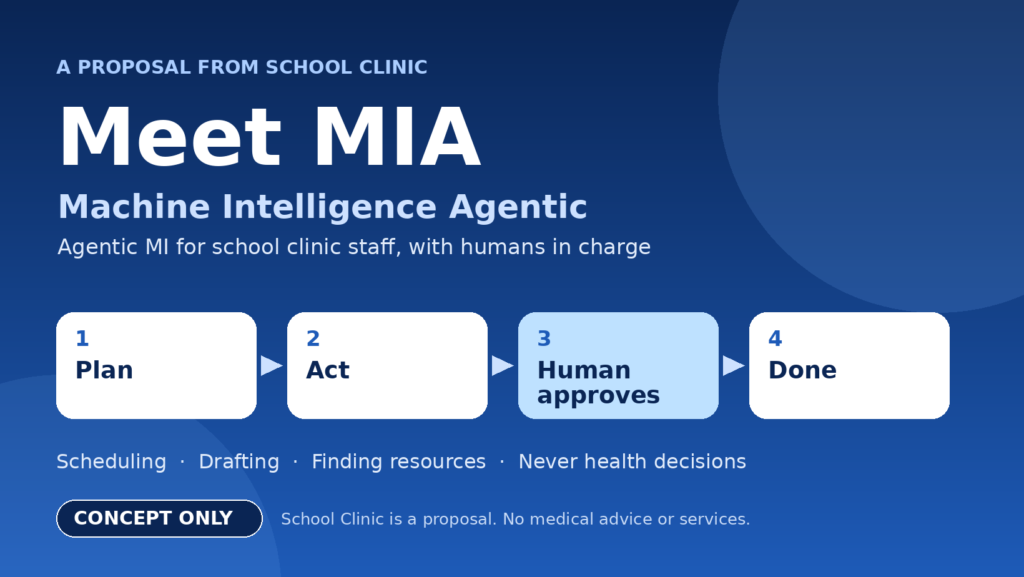
    Blue graphic reading Meet MIA, Machine Intelligence Agentic, with four steps: plan, act, human approves, done. Labeled concept only.
    Concept image only. School Clinic is a proposal, not a service.

    Five lessons for designing MIA

    To be clear, we are not proposing an MI yogo teacher. A yogo teacher’s warmth, judgment, and daily presence in a child’s life cannot be replaced by a machine. What we propose is that the yogo model, the values behind the role, could shape how MIA is designed to support the adults in a school clinic.

    1. Education first, not medicine. The yogo role sits inside education, and MEXT reminds us that a school is not a medical institution. MIA should follow the same line: help staff with general health education materials, schedules, and paperwork, and never diagnose, triage, or give medical advice.
    2. Body and mind together. Yogo teachers care for physical and emotional well-being at once. MIA should help staff see the whole picture, for example by keeping resource lists for counseling, food, and family support up to date, while leaving every judgment to people.
    3. Protect the safe room. The health room works because students trust a person there. MIA should free up that person’s time, not stand between them and a student. In School Clinic’s vision, MIA works for adult staff only and never communicates with anyone under 18.
    4. Coordinate the team. Yogo teachers connect class teachers, school doctors, dentists, pharmacists, parents, and community agencies. Coordination is exactly where agentic MI could help: scheduling health checks, tracking follow-ups, and drafting notices, all approved by a human. Our list of 101 ways an MI assistant could help social workers shows how much of this behind-the-scenes work exists.
    5. Value the people. Nippon.com notes that yogo teachers “are not sufficiently appreciated in Japan.” American school nurses face their own shortage, as we wrote in Too Few School Nurses, Too Much Paperwork. MIA should be used to give these professionals more time and recognition, never as a reason to cut their jobs.

    The MIA guardrails still apply

    • MIA supports adult staff and never contacts students under 18.
    • MIA makes no health decisions and gives no medical advice.
    • Humans approve every action, and every step is logged.
    • Privacy comes first, under laws such as FERPA and HIPAA. See FERPA and HIPAA, Explained Simply.
    • In an emergency or crisis, MIA stops and hands off to people right away.

    Learning across borders

    School health looks different in every country, and no single model fits everywhere. But the yogo teacher reminds us that school health can be built around education, trust, and a safe place to go, and that technology should strengthen those things, not replace them. We have also looked at nearly 40 years of school-based health centers in the United States. Together, these traditions give MIA a lot to learn from.

    Tell us what you think

    Have you worked as, or with, a yogo teacher? What should Americans understand about the role? Which parts of the yogo model could inspire school health in the US, and which should stay uniquely human?

    We invite college students, parents, school nurses, doctors, social workers, physician assistants (PAs), pharmacists, dietitians, physical therapists, educators, researchers, policymakers, and members of the public to participate.

    Get involved or email mail@school.clinic. School Clinic does not communicate with anyone under 18.

    Sources: Ministry of Education, Culture, Sports, Science and Technology (MEXT), “School Health Activities” (reference material, 2024); Kanako Okada, “The Yogo Teacher, the Health Room, and Health Education at School in Japan,” in Asian Perspectives and Evidence on Health Promotion and Education (Springer, 2011); Akiyama Chika, “A View from the School Health Center: Supporting Japanese Children’s Physical and Mental Well-Being,” Nippon.com, April 10, 2018.

    School Clinic is a proposal and offers no medical advice or services whatsoever. This post describes a possible future for discussion only. MIA is a proposed name, not a product or service, and is not affiliated with any Japanese organization. The featured image is a concept image only. School Clinic does not communicate with anyone under 18. In an emergency, call 911. In a mental health crisis, call or text 988.

  • Why the American College Health Association Belongs in the School Clinic Conversation

    Why the American College Health Association Belongs in the School Clinic Conversation

    If machine intelligence ever plays a role in campus health, the people who already run campus health should help shape it. For more than a century, many of those people have found a professional home in the American College Health Association (ACHA). In this post, we explain who ACHA is, why its expertise matters to the questions School Clinic is asking, and why we hope it will join the conversation.

    Reminder: School Clinic is a proposal. The clinic does not yet exist, and School Clinic offers no medical advice or services whatsoever. Everything below is a vision for discussion, not a product or a service. School Clinic has no partnership or affiliation with ACHA, and ACHA has not endorsed School Clinic or any idea in this post.

    Who ACHA is

    According to its website, the American College Health Association was founded in 1920 “to promote campus health care for students.” Its history page traces the field back even further, to 1861, when Amherst College named Dr. Edward Hitchcock as medical director of physical education, which is “generally given credit as the first college health service.”

    ACHA’s stated mission is simple: “ACHA empowers college health and well-being professionals to nurture and sustain healthy campus communities.” Its members include physicians, nurses, psychologists and counselors, health care administrators, health education specialists, student affairs staff, faculty, and campus leaders. ACHA says it represents about 12,000 members at more than 970 campuses, from four-year universities and community colleges to minority-serving institutions, HBCUs, and faith-based schools. It is based in Silver Spring, Maryland.

    What ACHA brings to the table

    • Data. The ACHA-National College Health Assessment (NCHA), which ACHA calls “a nationally recognized research survey,” gives campuses a picture of student health and well-being over time.
    • A whole-campus approach. ACHA’s Healthy Campus program “empowers campus communities to improve health and well-being,” with a framework campuses can use to plan.
    • Research. ACHA publishes the Journal of American College Health.
    • A professional community. ACHA has 11 regional affiliates and an annual meeting. ACHA 2027 was set for June 1-5, 2027, in Philadelphia.
    Person with glasses looking at colorful illustrated cards pinned to a teal wall
    Concept image only. School Clinic is a proposal, not a service.

    Why ACHA’s voice matters to School Clinic

    School Clinic is exploring how MI might one day support school clinics at every grade level, from kindergarten through college. College is where many of our first ideas begin, because college students are usually adults. Those are exactly the settings ACHA’s members know best. Here are questions where their experience could make a real difference:

    1. Where could MI help, and where should it never go? Our MIA proposal imagines agentic assistants that handle paperwork for staff while humans approve every step. Campus health professionals are the best judges of which tasks fit and which do not.
    2. Is a scheduling pilot the right first step? We have proposed a scheduling-only beta for adult college students. People who run campus health centers know what students actually struggle with.
    3. How do we protect privacy? Campus health records raise special questions under FERPA and other laws, as we explain in FERPA and HIPAA, Explained Simply.
    4. How do we keep crisis support human? Our post on campus mental health and the 988 Lifeline argues that MI must always point students to people. Counseling professionals can tell us how to make that real.
    5. How do we protect the workforce? Our first legislative proposal would bar using MI to replace human social workers. Campus health leaders can help us test whether that approach goes far enough.
    6. How would we measure success? With experience in campus-wide surveys like the NCHA, ACHA’s community understands how to measure student health honestly over time.

    An open invitation, including to critics

    We are not asking ACHA, or anyone, to agree with us. Some campus health professionals may think MI has no place in their work. That view belongs in the conversation too. What matters is that the people closest to students help set the rules before technology arrives, not after. We have made the same case for public health agencies, school boards and education agencies, and law schools.

    Tell us what you think

    Are you an ACHA member or a campus health professional? What should School Clinic understand about college health that outsiders often miss? Which of our ideas should be dropped, and which are worth exploring?

    We invite college students, parents, school nurses, doctors, social workers, physician assistants (PAs), pharmacists, dietitians, physical therapists, educators, researchers, policymakers, and members of the public to participate.

    Get involved or email mail@school.clinic. School Clinic does not communicate with anyone under 18.

    Source: American College Health Association website (acha.org), including its About, Mission and Vision, History, About Our Members, NCHA, and Healthy Campus pages, and annualmeeting.acha.org, read November 29, 2026. Membership figures are as stated by ACHA; its history page gives slightly different totals.

    School Clinic is a proposal and offers no medical advice or services whatsoever. This post describes a possible future for discussion only. School Clinic is not affiliated with or endorsed by the American College Health Association. The featured image is a concept image only. School Clinic does not communicate with anyone under 18. In an emergency, call 911. In a mental health crisis, call or text 988.

  • What MIA Could Learn From 40 Years of School-Based Health Centers

    What MIA Could Learn From 40 Years of School-Based Health Centers

    School-based health centers are not a new idea. In New Orleans, they have been part of the school day for nearly four decades. A new report from The Lens traces that history, from the city’s first clinic in the late 1980s to trailers set up after Hurricane Katrina. A week earlier, a new study in JAMA Pediatrics added fresh evidence about what these centers may mean for students. Together, they hold lessons for anyone imagining the next chapter of school health, including MIA, our proposed name for Machine Intelligence Agentic.

    Reminder: School Clinic is a proposal. The clinic does not yet exist, and School Clinic offers no medical advice or services whatsoever. Everything below is a vision for discussion, not a product or a service.

    Nearly 40 years of care where students already are

    According to The Lens, the clinic at G.W. Carver High School in the 9th Ward opened in the late 1980s as New Orleans’ first school-based clinic, with a $900,000 grant from the Robert Wood Johnson Foundation. After Katrina, the clinic at Chalmette High School in St. Bernard Parish opened in a trailer. More than 80 students came through on the first day. “It was insane,” nurse Heather Surcouf told the reporter.

    Today there are about 3,900 school-based health centers across the country, the article notes, citing federal figures. In Louisiana, the state health department’s adolescent school health program oversees 56 of them, and its manager, Faith Boudreaux, told The Lens that “more than 90% of the time,” students who visit are able to go back to class.

    The model keeps growing. In April 2026, Charles County, Maryland, opened its first school-based health center on the Indian Head Elementary School campus, a partnership between Charles County Public Schools and the county health department that, according to the school system, serves all students enrolled in its public schools.

    What the new research says

    The JAMA Pediatrics study, by researchers at RAND and MaineHealth, published online November 16, 2026, looked at 10 years of survey data from 87,871 eleventh graders at 180 Oregon schools. Access to a school-based health center was associated with fewer suicidal thoughts (down 2.7 percentage points), fewer suicide attempts (down 1.4 points), and fewer unmet emotional health care needs (down 2.1 points). The authors found no changes in physical health or unmet physical health needs. Their conclusion: access “was associated with improved mental health among high school students.”

    “Associated with” matters. This kind of study shows a link, not proof of cause and effect. Still, it is a strong signal that care located inside schools can reach students who might otherwise go without.

    Three students in school uniforms reading a picture book together in a classroom library
    Concept image only. School Clinic is a proposal, not a service.

    Six lessons for MIA

    MIA, as we describe it, is a kind of agentic MI assistant that would help adult staff with multi-step chores, always waiting for a human to approve. Here is what four decades of school health centers suggest it should learn.

    1. Go where students already are. School health centers work because they remove the trip, the wait, and the missed day. MIA should serve the people already on campus, by taking paperwork off their desks, not by adding another app or another login.
    2. Treat the whole person, through people. “If you don’t treat the person as a person in all their needs,” Surcouf said, “not only will they not learn — they won’t be healthy.” That kind of care comes from nurses, doctors, counselors, and social workers. MIA’s job is to give them more time for it.
    3. Hidden needs require trained humans. Laura Brey of the School-Based Health Alliance told The Lens that students may “present as being sick, but once you screen them, you find out that there’s something behavioral.” Recognizing that takes professional judgment. MIA should never screen, triage, or decide who gets care. It can prepare the forms and the schedule so a professional can do the screening.
    4. Keep students in class. Getting a student back to class “more than 90% of the time” depends on staff who can see students quickly. Every minute MIA saves on scheduling, reminders, and reports is a minute staff could spend with a student.
    5. Partnerships make it last. Carver started with a foundation grant. Charles County’s center is a school and health department partnership. Any MIA in a school clinic would need the same kind of partners: districts, campuses, health agencies, and the professionals who would supervise it.
    6. Measure honestly. We know more about school health centers because researchers studied them for years. MIA should be studied the same way, with clear goals, published results, and the humility to report what does not work. MI can also be confidently wrong, as we explain in When MI Makes Things Up.

    Support, never replacement

    The lesson running through every one of these stories is that people make school health work. In School Clinic’s vision, MIA would never replace a nurse, doctor, counselor, or social worker. It would be closer to the tireless assistant we describe in 101 Ways MI Social Workers Could Be the Best Personal Assistant a Social Worker Could Ever Want. Any system that touches student information would also need strong privacy protections from day one, like those in our proposed school.doctor beta login portal.

    Tell us what you think

    Have you worked in or with a school-based health center? What should the next 40 years learn from the last 40? Which chores would you hand to an assistant like MIA, and which should stay with people?

    We invite college students, parents, school nurses, doctors, social workers, physician assistants (PAs), pharmacists, dietitians, physical therapists, educators, researchers, policymakers, and members of the public to participate.

    Get involved or email mail@school.clinic. School Clinic does not communicate with anyone under 18.

    Sources: Vivi Smilgius, “From post-Katrina trailers to today: School health centers have bridged New Orleans’ deep care gaps for nearly 40 years,” The Lens, November 23, 2026; Kranz AM, et al., “School-Based Health Centers and Student Health Care Use, Need, and Health Outcomes,” JAMA Pediatrics, published online November 16, 2026, doi:10.1001/jamapediatrics.2026.5480; Charles County Public Schools press release on its first school-based health center, April 2026.

    School Clinic is a proposal and offers no medical advice or services whatsoever. This post describes a possible future for discussion only. MIA is a proposed name, not a product or service. The featured image is a concept image only. School Clinic does not communicate with anyone under 18. In an emergency, call 911. In a mental health crisis, call or text 988.

  • Too Few School Nurses, Too Much Paperwork: How MI Could Ease the Load

    Too Few School Nurses, Too Much Paperwork: How MI Could Ease the Load

    Ask a school nurse what takes up the day and you may hear about scraped knees, asthma inhalers, and worried parents. Then you may hear about the paperwork. Forms, logs, records, reminders, and reports fill the hours between students. At the same time, many schools do not have a full-time nurse at all. In this post, we look at the shortage and imagine how a supervised MI assistant, what we call MIA, for Machine Intelligence Agentic, could take some of that paperwork off a nurse’s desk.

    Reminder: School Clinic is a proposal. The clinic does not yet exist, and School Clinic offers no medical advice or services whatsoever. Everything below is a vision for discussion, not a product or a service.

    The shortage in numbers

    As Education Week reported, citing the National Association of School Nurses, only an estimated 65 percent of schools have a full-time school nurse. Coverage varies widely: about 70 percent of urban schools have one, compared with about 56 percent of rural schools, and the share in the West was reported at about 33 percent. The same report noted that more than 40 percent of school-age children have at least one chronic health condition, according to the CDC, and that in 2016 the American Academy of Pediatrics called an older guideline of one nurse per 750 students “inadequate” for students’ increasingly complex needs.

    Fewer nurses caring for more complex needs means every hour counts. When one nurse covers several buildings, an hour spent on forms is an hour away from students.

    Where the paperwork piles up

    Every district is different, but school nurses commonly handle tasks like these:

    • tracking immunization records and sending reminders about missing ones;
    • keeping medication and visit logs up to date;
    • collecting permission forms and physicals for sports, trips, and programs;
    • preparing health plans and making sure the right staff have copies;
    • scheduling screenings, such as vision and hearing days;
    • ordering and tracking supplies; and
    • compiling reports for the district, county, or state.

    None of these is unimportant. But many of them are repetitive, multi-step chores, exactly the kind of work agentic MI is designed to help with.

    Computer keyboard with a blue key labeled health
    Concept image only. School Clinic is a proposal, not a service.

    What a supervised MI assistant could do

    In School Clinic’s vision, a nurse’s MIA would work like a careful, tireless office assistant. It could:

    • Draft reminder letters to parents about missing forms, for the nurse to review, edit, and send.
    • Flag gaps, such as a missing signature or an expired form, so nothing slips through.
    • Organize screening days by checking calendars, booking rooms, and drafting announcements.
    • Prepare first drafts of reports from records the nurse already keeps, ready for the nurse to check and sign.
    • Track deadlines for trainings, license renewals, supply orders, and state reports.
    • Keep the resource list current, such as community programs and language services, with sources the nurse can verify.

    Many of these ideas mirror our list of 101 ways an MI assistant could help social workers. The principle is the same: give the paperwork to the machine and give the time back to people.

    Where the line is drawn

    • No clinical decisions. MIA would never assess a student, triage, give medication guidance, or decide who is seen first.
    • The nurse approves everything. Nothing is sent, signed, filed, or changed without the nurse’s yes.
    • Adults only. In K-12 schools, MIA would work for staff and would never contact students.
    • Privacy first. It would see only the information a task needs and follow laws such as FERPA and HIPAA. See our plain-language guide to FERPA and HIPAA.
    • No job cuts. Time saved must go back to students, never be used as a reason to cut nurses, hours, or pay. This is the same principle behind our first legislative proposal.

    An MI assistant cannot fix a shortage. Only more nurses can do that. But it might help the nurses we have spend more of their day doing what only they can do.

    Tell us what you think

    School nurses, we especially want to hear from you. Which tasks eat the most time? Which would you happily hand to an assistant, and which should never leave your hands?

    We invite college students, parents, school nurses, doctors, social workers, physician assistants (PAs), pharmacists, dietitians, physical therapists, educators, researchers, policymakers, and members of the public to participate.

    Get involved or email mail@school.clinic. School Clinic does not communicate with anyone under 18.

    Source: Elizabeth Heubeck, “What School Nurses Do, and Why Schools Need More of Them,” Education Week, September 6, 2023, citing the National Association of School Nurses, the CDC, and the American Academy of Pediatrics.

    School Clinic is a proposal and offers no medical advice or services whatsoever. This post describes a possible future for discussion only. MIA is a proposed name, not a product or service. The featured image is a concept image only. School Clinic does not communicate with anyone under 18. In an emergency, call 911. In a mental health crisis, call or text 988.