If you are in crisis or worried about someone, call or text 988, or chat at 988lifeline.org. In an emergency, call 911.
College can be one of the most exciting times in a person’s life. It can also be one of the hardest. Moving away from home, money worries, classes, jobs, and relationships all pile up at once. In this post, we look at what recent research says about college student mental health, why the 988 Suicide & Crisis Lifeline matters on campus, and how future technology should always point students toward people.
Reminder: School Clinic is a proposal. The clinic does not yet exist, and School Clinic offers no medical advice or services whatsoever. Everything below is a vision for discussion, not a product or a service.
What the numbers say
The Healthy Minds Study, which surveyed more than 84,000 students at 135 colleges and universities in 2024-2025, brought some encouraging news: for the third year in a row, students reported lower rates of depression, anxiety, and suicidal thoughts. Moderate to severe depression symptoms fell from 44 percent in 2022 to 37 percent in 2025. Moderate to severe anxiety fell from 37 percent to 32 percent. The share of students who seriously considered suicide in the past year fell from 15 percent to 11 percent.
That progress is real. But 11 percent still means more than one in ten students. The same study found that lack of time and cost were among the most common reasons students gave for not getting help.
What 988 is
Since July 2022, anyone in the United States can reach the 988 Suicide & Crisis Lifeline by calling or texting 988, or by chatting online at 988lifeline.org. It is free, confidential, and available 24 hours a day, seven days a week. People can reach out for themselves or for someone they are worried about, and you do not have to be suicidal to use it. Emotional distress, a mental health crisis, or a substance use concern are all reasons to reach out.

Making 988 impossible to miss on campus
A lifeline only helps if people know it is there. Here are ideas campuses already use or could explore:
- Put it everywhere students look. Student ID cards, residence hall doors, learning management systems, course syllabi, and the campus app.
- Pair it with local help. List 988 alongside the campus counseling center’s hours and after-hours line, so students know both options.
- Train the people students already trust. Resident assistants, coaches, advisors, and faculty can learn how to recognize distress and share 988.
- Talk about it early and often. Orientation, midterms, and finals week are natural moments to remind everyone.
- Remember faculty and staff too. The Healthy Minds faculty and staff survey found burnout is common among the adults who support students.
Where MI fits, and where it does not
School Clinic imagines a future in which machine intelligence supports campus health teams. When it comes to mental health crises, our position is simple: MI must always point to people, never stand in for them.
Our principles for MI and crisis support
- Always show 988 and 911. Any MI tool on a campus should make these numbers visible at all times.
- Stop and hand off. If a conversation touches a crisis, the MI stops and connects the person with humans right away. It never handles a crisis by itself.
- No counseling or diagnosis. MI would never assess risk, counsel, or diagnose. Those are jobs for licensed professionals.
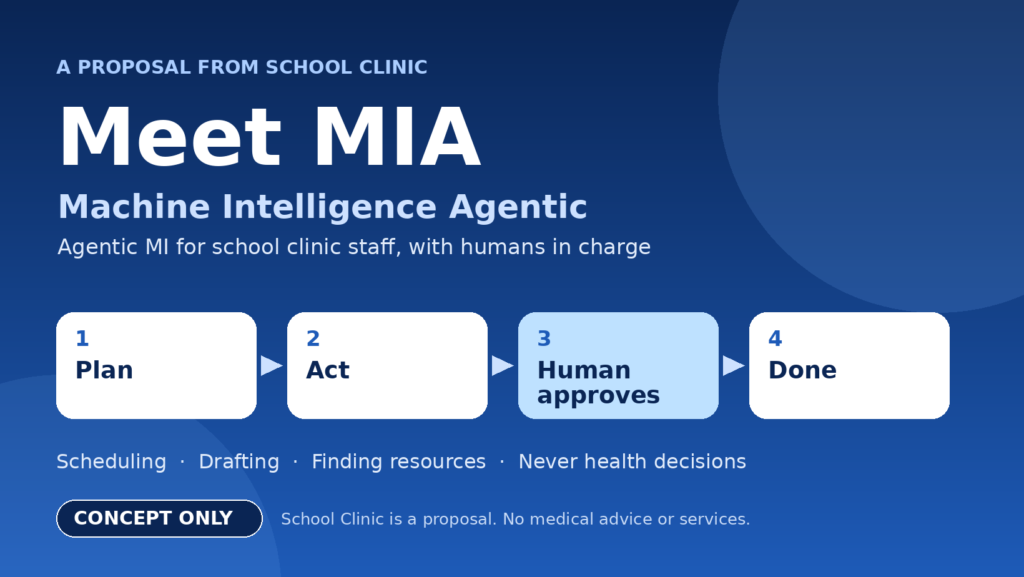
- Free up the humans. Agentic tools like MIA could take on counseling center scheduling, reminders, and paperwork, so counselors have more time for students.
- Human supervision, always. Our first legislative proposal describes supervised MI support for students 18 and older that never replaces human social workers, and our post on 101 ways MI could help social workers shows how much behind-the-scenes work could be lifted.
MI can also be confidently wrong, which is one more reason crisis support belongs with trained people. We explain why in When MI Makes Things Up.
Tell us what you think
How does your campus share 988? What has worked, and what has not? If you work in a counseling center, which tasks would you most like an assistant to take on?
We invite college students, parents, school nurses, doctors, social workers, physician assistants (PAs), pharmacists, dietitians, physical therapists, educators, researchers, policymakers, and members of the public to participate.
Get involved or email mail@school.clinic. School Clinic does not communicate with anyone under 18, and our inbox is not a crisis line. If you need help now, call or text 988.
Source: University of Michigan School of Public Health, “Healthy Minds Study: College student depression, anxiety decline for third consecutive year” (2024-2025 data).
School Clinic is a proposal and offers no medical advice or services whatsoever. This post describes a possible future for discussion only and is not a substitute for professional help. The featured image is a concept image only. School Clinic does not communicate with anyone under 18. In an emergency, call 911. In a mental health crisis, call or text 988.