
Tag: Agentic MI

  • LLM Servers for School Clinics: A 2026 Product Review

    LLM Servers for School Clinics: A 2026 Product Review

    Independent review. School Clinic has no affiliation with any company named here and received no payment, sponsorship, free product, or endorsement. School Clinic is a proposal, not a clinic. This article is part of our CSC (Continuity of School Clinic) series and is general education only. It is not medical, legal, IT-security, or purchasing advice. Prices are as reported on the dates noted and change often.

    In our companion guide to backup laptops, we explained why a protected, solar-ready laptop is the right MI tool for an emergency. We also noted that on-site servers still have a place in everyday operations. This review looks at that side of the question: if a college or university health service wanted to run its own language models, on its own hardware, with no student data leaving the building, what could it buy in 2026?

    Why a clinic might want its own MI server

    • Data control. Health records and notes stay on equipment the institution owns, rather than being sent to a cloud provider.
    • Shared use. One machine can serve a whole team of clinicians and staff, instead of one laptop per person.
    • Predictable cost. A one-time purchase instead of per-user subscription fees, although power, maintenance, and IT time still cost money.
    • Larger models. More memory means larger, more capable open-weight models and longer documents.

    The 2026 options at a glance

    OptionMemory for modelsReported priceSize and noiseBest fit
    AMD Ryzen AI Max+ mini PC (for example, Framework Desktop) Entry point128 GB (up to 96 GB for graphics); a 192 GB version announced in 2026About $3,449 for 128 GB; $6,799 for 192 GB (September 2026)4.5-liter mini PC; quietA small clinic team piloting local MI
    NVIDIA DGX Spark (and partner GB10 systems)128 GB unified memory$4,699 list price (after a February 2026 increase)Palm-sized, about 1.1 litersSmall teams that want NVIDIA’s software ecosystem
    Apple Mac Studio (M5 Max or M5 Ultra) Most memory per dollarM5 Max up to 128 GB; M5 Ultra up to 512 GBFrom $2,499 (M5 Max) and $5,499 (M5 Ultra); 512 GB expected above $10,000Compact desktop; quietRunning very large models in an office setting
    Workstation tower with RTX PRO 6000 Blackwell (built by Dell, HP, Lenovo, Puget, Lambda, Bizon, and others)96 GB of graphics memory per card; one or more cardsThe card alone was reported at $8,500+ in early 2026, with later reports of sharp increases; full systems cost moreFull tower; up to 600 W per card, audible under loadA larger health service with campus IT support
    NVIDIA DGX Station / Dell Pro Max with GB300About 748 GB total (252 GB GPU plus 496 GB system)Listed from about $95,000 (August 2026)Large liquid-cooled tower; 1,600 W power supplyResearch-scale work; overkill for most clinics
    Rack servers (Dell, HPE, Lenovo, Supermicro)Several GPUs per serverTypically quoted per project; often well into six figuresLoud; needs a data center with coolingUniversity-wide platforms run by central IT
    On-premises MI hardware options in 2026, based on manufacturer pages and news reports from February to November 2026. Prices are as reported on those dates and are not quotes. This is not an endorsement or a buying recommendation.

    Product notes

    AMD Ryzen AI Max+ mini PCs

    The same AMD chip family found in high-end laptops also powers small desktops. The Framework Desktop offers 128 GB of memory, up to 96 GB of which can be assigned to graphics, in a 4.5-liter case, and Framework says it can run Llama 3.3 70B. In September 2026, Phoronix reported the 128 GB model at about $3,449 and a new 192 GB version at $6,799. For a clinic, this is the most affordable way to try a shared local model.

    NVIDIA DGX Spark

    NVIDIA’s DGX Spark packs its GB10 chip and 128 GB of unified memory into a box about six inches square. Tom’s Hardware found that its 128 GB “makes it easy to run most local AI models.” Notebookcheck reported a $700 price increase in February 2026, to a $4,699 list price. Partner versions of the same design are sold by other computer makers. It suits teams that want NVIDIA’s widely used AI software tools in a small, office-friendly box.

    Apple Mac Studio

    Apple’s 2026 Mac Studio offers up to 128 GB of memory with the M5 Max chip and up to 512 GB with the M5 Ultra. MacRumors lists US prices starting at $2,499 and $5,499, with the 512 GB model expected above $10,000. That much memory can hold very large open-weight models in a quiet desktop that fits on a shelf. The trade-off is that many hospital and campus IT departments are built around Windows and Linux, so support should be confirmed first.

    Workstations with RTX PRO 6000 Blackwell

    NVIDIA’s RTX PRO 6000 Blackwell has 96 GB of graphics memory with error correction and draws up to 600 W. Workstation builders such as Dell, HP, Lenovo, Puget Systems, Lambda, and Bizon offer towers with one or more of these cards. They are the fastest option for serving several users at once, but they are expensive, power-hungry, and best managed by campus IT.

    DGX Station and rack servers

    At the top end, the GB300-based DGX Station was listed from about $95,000 in August 2026, with roughly 748 GB of memory and a 1,600 W power supply. Dell sells a similar Pro Max with GB300. Multi-GPU rack servers from Dell, HPE, Lenovo, and Supermicro sit in data centers. These make sense for a university research platform, not a single health center.

    Which option fits which clinic?

    SettingRealistic starting pointWhy
    K-12 school nurse officeNo server; work through the districtStudent health records often fall under FERPA and district policy; any MI tool should be chosen and managed at the district level
    Small college health center Good first stepRyzen AI Max+ mini PC, DGX Spark, or Mac StudioLow cost, quiet, office-friendly, enough memory for strong mid-size models
    Large university health serviceRTX PRO 6000 workstation or a hosted machine in the campus data centerServes many users at once; campus IT provides security, backups, and monitoring
    University-wide or research useDGX Station or rack servers run by central ITLarge scale, high cost, needs data center power and cooling
    A general guide only. Every institution should decide with its IT, privacy, legal, and clinical leaders.

    Models and software

    The open-weight models covered in our laptop guide, including Gemma, Qwen, gpt-oss, Mistral, Llama, and Phi, run on all of these machines. More memory allows larger models: 128 GB comfortably holds models in the 70B to 120B range in compressed form, while 512 GB or more can hold some of the largest open-weight models available. Tools such as Ollama, LM Studio, and llama.cpp work well for small teams, while server software such as vLLM is designed for many users at once.

    On-premises does not mean automatically compliant

    • HIPAA and FERPA still apply. Keeping data in-house avoids sending it to a cloud provider, but the institution must still apply HIPAA Security Rule safeguards, FERPA where it governs records, and state privacy law.
    • Security basics. Encryption, access controls, audit logs, patching, backups, and physical security are all the institution’s responsibility.
    • Human review. A licensed professional reviews every output. The model makes no clinical decisions.
    • Licences. Check each model’s licence for permitted uses.
    • Adults only. Any use involving students under 18 must be by licensed adult staff under school and parental consent policies.

    Servers for every day, laptops for emergencies

    A server room is a single point of failure when the grid goes down, and most of these machines depend on wall power, cooling, and a working network. That is why the CSC series recommends pairing any on-site server with a protected backup laptop that can run a smaller model on battery or solar power. The server handles everyday work; the laptop keeps essential help available during an emergency, as described in CSC Part 1.

    Both fit School Clinic’s MIA (Machine Intelligence Agentic) vision: MI that drafts, summarizes, and organizes, with a human approving every action. As of 2026, School Clinic’s MI vision is limited to general health and wellness education and administrative support, supervised by licensed humans, with greater autonomy only if and when laws allow.

    Would your health service run its own MI server? We invite college students, parents, school nurses, doctors, social workers, educators, researchers, policymakers, pharmacists, dietitians, physical therapists, physician assistants, IT professionals, emergency managers, and members of the public (adults 18 and over) to share your views through our Get Involved page.

    When a campus experiences a disaster, its healthcare services must be prepared to continue operating. Preparedness today helps ensure continuity of care tomorrow.

    The CSC series, School Clinic

    Sources

    AMD, Ryzen, Framework, NVIDIA, DGX, RTX, Apple, Mac Studio, Dell, HP, HPE, Lenovo, Supermicro, Puget Systems, Lambda, Bizon, and the model and software names mentioned are trademarks of their owners and are used here only to identify products. Prices and specifications change often; confirm details with each maker before purchasing. We did not test these products ourselves.

    Disclaimer: School Clinic is a proposal and offers no medical advice or services whatsoever. This article is general education and product commentary only. It is not medical, legal, IT-security, or purchasing advice, and it is not an operational plan for any institution. Any use of MI tools with health information must follow applicable law and institutional policy, with licensed human review. School Clinic does not communicate with anyone under 18. In an emergency, call 911. In a mental health crisis, call or text 988.

  • CSC Companion: Choosing a Backup Laptop That Can Run Local MI for the Campus Clinic

    CSC Companion: Choosing a Backup Laptop That Can Run Local MI for the Campus Clinic

    About the CSC series. CSC, short for Continuity of School Clinic, is School Clinic’s ongoing educational series on how school and campus health services can prepare for, respond to, and keep essential care going during emergencies. This companion post expands on one idea from CSC Part 1: When the Grid Goes Down, Can the Campus Clinic Keep Going? School Clinic is a proposal, not a clinic. This post is general education only. It is not medical, legal, IT-security, or purchasing advice, and School Clinic has no affiliation with, and receives nothing from, any company or model named here.

    In CSC Part 1, we suggested that a campus clinic keep a protected backup device: a charged laptop and an encrypted drive, stored in a Faraday bag and paired with a portable solar battery backup. We also suggested considering a laptop powerful enough to run a small language model locally, with no internet connection at all. This post looks at what that means in practice: which kinds of laptops can do it, which open-weight models fit them, and how a clinic could use them safely during a long outage.

    Why “local” matters in an outage

    Most MI tools today run in the cloud. When the grid fails, internet and cell service can fail with it, and cloud tools disappear just when staff are most stretched. A local model runs entirely on the laptop. It needs no connection, and the data it reads never leaves the device. That makes it a natural fit for a continuity plan, and an early, offline step toward School Clinic’s MIA (Machine Intelligence Agentic) vision.

    The one spec that matters most: memory

    A language model has to fit in memory to run well. On Apple and AMD “unified memory” laptops, the processor and graphics share one large pool. On laptops with a separate NVIDIA graphics card, the model must fit in the card’s own video memory (VRAM). As a rough guide, aim for at least 32 GB of memory (64 GB or more is better) and a 1 TB or larger SSD for the models, the continuity plan, and downtime records.

    Three classes of capable laptops

    FeatureApple MacBook Pro (M5 Pro or M5 Max)AMD Ryzen AI Max+ laptops (for example, HP ZBook Ultra G1a)NVIDIA RTX 5080 or 5090 laptops
    Memory for models Key differenceUnified memory: M5 Pro up to 64 GB; M5 Max up to 128 GBUp to 128 GB unified memory; HP says up to 96 GB can be assigned to graphicsSeparate VRAM: 16 GB (RTX 5080) or 24 GB (RTX 5090), plus system RAM
    Operating systemmacOSWindows (Linux possible)Windows (Linux possible)
    Power and battery Key differenceVery efficient; Apple lists up to 22 to 24 hours of video playback on the 16-inch modelModerate power draw; HP lists 140 W chargingGraphics alone can draw 80 to 150 W, so batteries drain fast
    Largest practical modelsWith 128 GB, models of 100B+ parameters (quantized)With 128 GB, models of 70B to 120B (quantized)About 20B to 30B models fit fully in 24 GB of VRAM
    SpeedFast, especially with very long documentsModerateFastest on models that fit in VRAM
    Fit with solar backupBestGoodWeakest
    Three classes of laptops that can run local language models, based on manufacturer specifications and published reviews checked November 29, 2026. Other laptops in each class exist. This is not an endorsement or a buying recommendation.

    Apple MacBook Pro. Apple’s 2026 14-inch and 16-inch MacBook Pro models with the M5 Pro or M5 Max chip offer up to 64 GB (M5 Pro) or 128 GB (M5 Max) of unified memory. Because they deliver strong performance at low power, they pair best with a portable solar power station.

    AMD Ryzen AI Max+ laptops. The HP ZBook Ultra G1a uses AMD’s Ryzen AI Max+ PRO processors with up to 128 GB of unified memory, and HP markets it for working with LLMs “locally and offline.” Other designs, such as the ASUS ROG Flow Z13 tablet, use the same family of chips. These are a strong choice for clinics standardized on Windows.

    NVIDIA RTX laptops. According to Tom’s Hardware, the RTX 5090 laptop GPU has 24 GB of VRAM and the RTX 5080 has 16 GB, with power limits set by each laptop maker between roughly 80 and 150 W. They are the fastest option for models that fit, but in a reported head-to-head test, a 128 GB M5 Max ran a 122-billion-parameter model that a 24 GB RTX 5090 could not hold at all.

    Which local models could run on them

    “Open-weight” models can be downloaded and run on your own hardware. The field changes every few months, so treat the names below as examples as of late 2026, not a final list. Sizes assume common 4-bit “quantized” versions, which shrink a model so it fits in less memory.

    Memory availableExample open-weight modelsGood for
    16 GBGemma 4 12B, gpt-oss-20b, Qwen 3.5 9B, Ministral 3 14B, Phi familyShort drafts, summaries of single forms, quick questions about the plan
    32 GB Sweet spotQwen 3.8 27B, Gemma 4 26B or 31B, Qwen 3.6 35B-A3BMost clinic tasks: drafting, summarizing batches of forms, searching long plans
    64 GBThe 32 GB models at higher quality, with room for long documentsLonger documents and more accurate output
    96 to 128 GBgpt-oss-120b, Qwen 3.5 122B, Llama 4 Scout, Mistral Small 4The most capable offline assistance, at higher power draw
    Example open-weight models by memory size, based on published local-model guides from October and November 2026. Model names, sizes, and licences change often. Check each model’s official card and licence before use.

    Runtimes. Free tools such as Ollama, LM Studio, and llama.cpp download and run these models on macOS, Windows, and Linux, and Apple’s MLX framework is optimized for Apple chips. The key step for a continuity plan is to download the runtime and models in advance, then test them with the internet switched off. A model you cannot download during an outage is no help.

    How a clinic could use it during an outage

    • Drafting notes. Turn a clinician’s quick, typed or dictated observations into a structured draft note that the clinician then edits and signs.
    • Summarizing downtime forms. Condense stacks of paper downtime records, once typed or scanned, into summaries ready for entry into the electronic health record after power returns.
    • Searching the continuity plan. Ask plain-language questions such as “Who is our alternate vaccine storage contact?” and get the answer with the page it came from.
    • Drafting communications. Prepare first drafts of staff updates and student notices for a human to review before anything is sent.
    • Checklists and logs. Keep running shift logs, supply counts, and to-do lists in one place.

    Safeguards that come first

    • A human reviews everything. Every note, summary, or message is checked by a licensed professional before it is saved or shared. Local models make mistakes, and smaller models make more of them.
    • No clinical decisions. The model never diagnoses, triages, or recommends treatment. It assists with paperwork and information, nothing more.
    • Data stays encrypted on the device. Use full-disk encryption, strong passwords, and an encrypted external drive. Health information is handled under HIPAA, FERPA, state law, and campus IT and privacy policies, and campus IT should approve the setup.
    • Licences and testing. Check each model’s licence and test its accuracy on sample, non-real data before relying on it.
    • Power draw. Running a model uses more battery than ordinary work. Plan solar and battery capacity for it, and use smaller models when power is scarce.
    • Physical protection. Store the laptop and drive in a Faraday bag, keep them charged, and update the software and plan on a set schedule.
    • Adults only. Any use involving students under 18 must be by licensed adult staff under school and parental consent policies.

    The MIA connection

    School Clinic’s MIA vision imagines agentic MI that prepares, drafts, and organizes, while a human approves every action. A local model on a protected, solar-powered laptop is a modest, practical version of that idea: an assistant that still works when everything else is down. As of 2026, School Clinic’s MI vision is limited to general health and wellness education and administrative support, supervised by licensed humans, with greater autonomy only if and when laws allow.

    Quick checklist

    • ☐ Laptop with at least 32 GB of memory (64 GB or more preferred) and a 1 TB or larger SSD
    • ☐ Runtime and models downloaded in advance and tested offline
    • ☐ Continuity plan, contact lists, and downtime forms stored locally and encrypted
    • ☐ Campus IT and privacy approval for the setup
    • ☐ Solar power station sized for the laptop’s power draw
    • ☐ Faraday bag for storage, with a regular charging and update schedule
    • ☐ Written rule that a licensed human reviews every output

    Afterword: why laptops, not LLM servers

    Some readers may ask why CSC suggests a laptop instead of an on-site LLM server, the kind of rack-mounted machine larger organizations use to run AI models for many users at once. For a continuity plan, we chose laptops for three reasons.

    Cost. A capable laptop costs a few thousand dollars. A GPU server can cost tens of thousands of dollars or more, before adding the dedicated room, cooling, networking, and IT staff time it needs. For a campus clinic, a laptop puts offline MI within reach of an ordinary budget.

    Energy efficiency. A laptop runs on its own battery and can be recharged from a portable solar power station. A server draws far more power, often measured in kilowatts, and depends on the same generators and air conditioning that may already be stretched or failing during a grid outage. In an emergency, every watt matters.

    Portability and survivability. A laptop can be picked up and carried to an alternate care site, evacuated with staff, or stored in a Faraday bag between uses. A server room is a single point of failure: if the building floods, loses cooling, or must be closed, the server goes with it. In a disaster, the tool that survives is the one that can move.

    On-site servers still have a place. For everyday operations at a large health service, with many users and steady power, they may be the right choice; see our 2026 review of LLM servers for school clinics. But for continuity of care when the grid fails, a protected, solar-ready laptop is simpler, cheaper, and far more likely to be working when it is needed most.

    Do you work in campus health, IT, or emergency management? We invite college students, parents, school nurses, doctors, social workers, educators, researchers, policymakers, pharmacists, dietitians, physical therapists, physician assistants, emergency managers, and members of the public (adults 18 and over) to share your views through our Get Involved page.

    When a campus experiences a disaster, its healthcare services must be prepared to continue operating. Preparedness today helps ensure continuity of care tomorrow.

    The CSC series, School Clinic

    Sources

    Apple, MacBook Pro, HP, ZBook, AMD, Ryzen, ASUS, ROG, NVIDIA, RTX, and the model and software names mentioned are trademarks of their owners and are used here only to identify products. Specifications, prices, and model availability change often; confirm details with each maker before purchasing. Benchmark figures are from third-party tests we did not reproduce.

    Disclaimer: School Clinic is a proposal and offers no medical advice or services whatsoever. This article is general education only. It is not medical, legal, IT-security, or purchasing advice, and it is not an operational plan for any institution. Any use of MI tools with health information must follow applicable law and institutional policy, with licensed human review. School Clinic does not communicate with anyone under 18. In an emergency, call 911. In a mental health crisis, call or text 988.
  • Learning From Japan’s Yogo Teachers: A Model for the Future MIA

    Learning From Japan’s Yogo Teachers: A Model for the Future MIA

    When people imagine the future of school health, they often look to hospitals and clinics. Japan offers a different picture. In Japanese schools, health care begins with an educator: the yogo teacher (yōgo kyōyu, 養護教諭), who runs the school health room and looks after students’ bodies and minds. In this post, we ask whether the yogo model could guide how we design MIA, our proposed name for Machine Intelligence Agentic.

    Reminder: School Clinic is a proposal. The clinic does not yet exist, and School Clinic offers no medical advice or services whatsoever. Everything below is a vision for discussion, not a product or a service.

    Who yogo teachers are

    According to Japan’s Ministry of Education (MEXT), “A yogo teacher is a teaching staff, who plays a pivotal role to promote school health activities.” Kanako Okada of Chiba University describes yogo teachers as “special licensed educators who support children’s growth and development through health education and health services,” and notes that most Japanese schools have one or more yogo teachers “instead of school nurses.”

    As Nippon.com explains, Japan once had school nurses much like those in the West, but in Japan the role became part of the teaching staff. Yogo teachers train for the position, usually at university, and earn a teaching license. A nursing license is not required.

    The health room: a safe place for every student

    MEXT says each school in Japan has a school health room, the hokenshitsu, “for health checks, health counseling and guidance, and first aid,” and that “all students can use this room at any time.” Yogo teachers manage that room. Their work, as MEXT describes it, includes first aid, health checks, daily health observation, infection prevention, school hygiene, health counseling and guidance, and teaching.

    The health room is about more than scraped knees. Nippon.com reports that on a busy day, as many as 60 children might visit the yogo teacher at a school of more than 500 students. For some students who struggle with the classroom, the health room becomes the place where they can still come to school. Japan even has a word for it: hokenshitsu tōkō, attending school by spending time in the health room.

    A team, not a lone hero

    Yogo teachers do not work alone. MEXT notes that Japanese schools are required to have a school doctor, a school dentist, and a school pharmacist. Class teachers do daily health observation, and schools work with public health centers, child guidance centers, and others. MEXT also makes a point worth remembering: “a school is not a medical institution but educational one,” so first aid at school is “a temporary measure.”

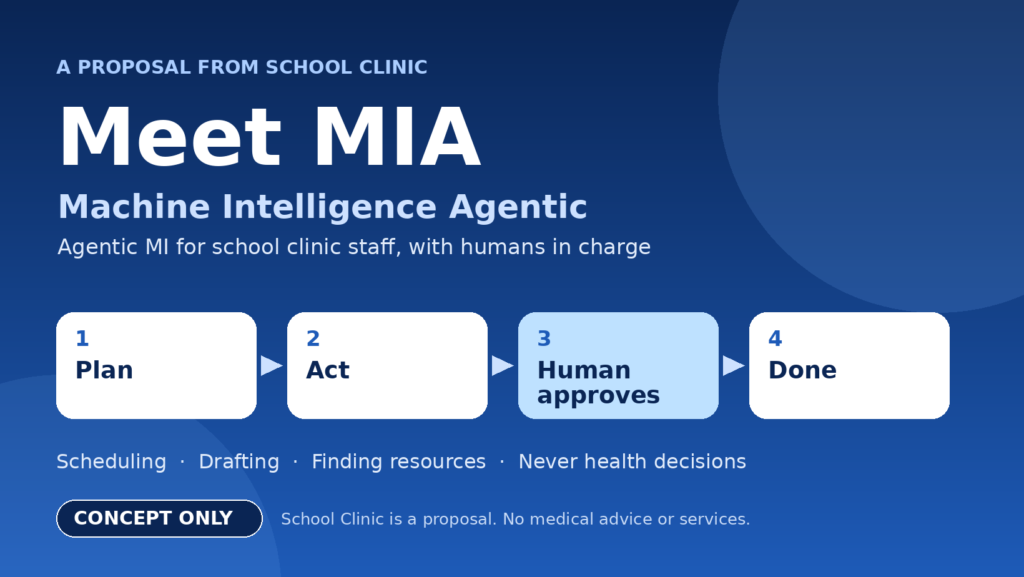
    Blue graphic reading Meet MIA, Machine Intelligence Agentic, with four steps: plan, act, human approves, done. Labeled concept only.
    Concept image only. School Clinic is a proposal, not a service.

    Five lessons for designing MIA

    To be clear, we are not proposing an MI yogo teacher. A yogo teacher’s warmth, judgment, and daily presence in a child’s life cannot be replaced by a machine. What we propose is that the yogo model, the values behind the role, could shape how MIA is designed to support the adults in a school clinic.

    1. Education first, not medicine. The yogo role sits inside education, and MEXT reminds us that a school is not a medical institution. MIA should follow the same line: help staff with general health education materials, schedules, and paperwork, and never diagnose, triage, or give medical advice.
    2. Body and mind together. Yogo teachers care for physical and emotional well-being at once. MIA should help staff see the whole picture, for example by keeping resource lists for counseling, food, and family support up to date, while leaving every judgment to people.
    3. Protect the safe room. The health room works because students trust a person there. MIA should free up that person’s time, not stand between them and a student. In School Clinic’s vision, MIA works for adult staff only and never communicates with anyone under 18.
    4. Coordinate the team. Yogo teachers connect class teachers, school doctors, dentists, pharmacists, parents, and community agencies. Coordination is exactly where agentic MI could help: scheduling health checks, tracking follow-ups, and drafting notices, all approved by a human. Our list of 101 ways an MI assistant could help social workers shows how much of this behind-the-scenes work exists.
    5. Value the people. Nippon.com notes that yogo teachers “are not sufficiently appreciated in Japan.” American school nurses face their own shortage, as we wrote in Too Few School Nurses, Too Much Paperwork. MIA should be used to give these professionals more time and recognition, never as a reason to cut their jobs.

    The MIA guardrails still apply

    • MIA supports adult staff and never contacts students under 18.
    • MIA makes no health decisions and gives no medical advice.
    • Humans approve every action, and every step is logged.
    • Privacy comes first, under laws such as FERPA and HIPAA. See FERPA and HIPAA, Explained Simply.
    • In an emergency or crisis, MIA stops and hands off to people right away.

    Learning across borders

    School health looks different in every country, and no single model fits everywhere. But the yogo teacher reminds us that school health can be built around education, trust, and a safe place to go, and that technology should strengthen those things, not replace them. We have also looked at nearly 40 years of school-based health centers in the United States. Together, these traditions give MIA a lot to learn from.

    Tell us what you think

    Have you worked as, or with, a yogo teacher? What should Americans understand about the role? Which parts of the yogo model could inspire school health in the US, and which should stay uniquely human?

    We invite college students, parents, school nurses, doctors, social workers, physician assistants (PAs), pharmacists, dietitians, physical therapists, educators, researchers, policymakers, and members of the public to participate.

    Get involved or email mail@school.clinic. School Clinic does not communicate with anyone under 18.

    Sources: Ministry of Education, Culture, Sports, Science and Technology (MEXT), “School Health Activities” (reference material, 2024); Kanako Okada, “The Yogo Teacher, the Health Room, and Health Education at School in Japan,” in Asian Perspectives and Evidence on Health Promotion and Education (Springer, 2011); Akiyama Chika, “A View from the School Health Center: Supporting Japanese Children’s Physical and Mental Well-Being,” Nippon.com, April 10, 2018.

    School Clinic is a proposal and offers no medical advice or services whatsoever. This post describes a possible future for discussion only. MIA is a proposed name, not a product or service, and is not affiliated with any Japanese organization. The featured image is a concept image only. School Clinic does not communicate with anyone under 18. In an emergency, call 911. In a mental health crisis, call or text 988.

  • Why the American College Health Association Belongs in the School Clinic Conversation

    Why the American College Health Association Belongs in the School Clinic Conversation

    If machine intelligence ever plays a role in campus health, the people who already run campus health should help shape it. For more than a century, many of those people have found a professional home in the American College Health Association (ACHA). In this post, we explain who ACHA is, why its expertise matters to the questions School Clinic is asking, and why we hope it will join the conversation.

    Reminder: School Clinic is a proposal. The clinic does not yet exist, and School Clinic offers no medical advice or services whatsoever. Everything below is a vision for discussion, not a product or a service. School Clinic has no partnership or affiliation with ACHA, and ACHA has not endorsed School Clinic or any idea in this post.

    Who ACHA is

    According to its website, the American College Health Association was founded in 1920 “to promote campus health care for students.” Its history page traces the field back even further, to 1861, when Amherst College named Dr. Edward Hitchcock as medical director of physical education, which is “generally given credit as the first college health service.”

    ACHA’s stated mission is simple: “ACHA empowers college health and well-being professionals to nurture and sustain healthy campus communities.” Its members include physicians, nurses, psychologists and counselors, health care administrators, health education specialists, student affairs staff, faculty, and campus leaders. ACHA says it represents about 12,000 members at more than 970 campuses, from four-year universities and community colleges to minority-serving institutions, HBCUs, and faith-based schools. It is based in Silver Spring, Maryland.

    What ACHA brings to the table

    • Data. The ACHA-National College Health Assessment (NCHA), which ACHA calls “a nationally recognized research survey,” gives campuses a picture of student health and well-being over time.
    • A whole-campus approach. ACHA’s Healthy Campus program “empowers campus communities to improve health and well-being,” with a framework campuses can use to plan.
    • Research. ACHA publishes the Journal of American College Health.
    • A professional community. ACHA has 11 regional affiliates and an annual meeting. ACHA 2027 was set for June 1-5, 2027, in Philadelphia.
    Person with glasses looking at colorful illustrated cards pinned to a teal wall
    Concept image only. School Clinic is a proposal, not a service.

    Why ACHA’s voice matters to School Clinic

    School Clinic is exploring how MI might one day support school clinics at every grade level, from kindergarten through college. College is where many of our first ideas begin, because college students are usually adults. Those are exactly the settings ACHA’s members know best. Here are questions where their experience could make a real difference:

    1. Where could MI help, and where should it never go? Our MIA proposal imagines agentic assistants that handle paperwork for staff while humans approve every step. Campus health professionals are the best judges of which tasks fit and which do not.
    2. Is a scheduling pilot the right first step? We have proposed a scheduling-only beta for adult college students. People who run campus health centers know what students actually struggle with.
    3. How do we protect privacy? Campus health records raise special questions under FERPA and other laws, as we explain in FERPA and HIPAA, Explained Simply.
    4. How do we keep crisis support human? Our post on campus mental health and the 988 Lifeline argues that MI must always point students to people. Counseling professionals can tell us how to make that real.
    5. How do we protect the workforce? Our first legislative proposal would bar using MI to replace human social workers. Campus health leaders can help us test whether that approach goes far enough.
    6. How would we measure success? With experience in campus-wide surveys like the NCHA, ACHA’s community understands how to measure student health honestly over time.

    An open invitation, including to critics

    We are not asking ACHA, or anyone, to agree with us. Some campus health professionals may think MI has no place in their work. That view belongs in the conversation too. What matters is that the people closest to students help set the rules before technology arrives, not after. We have made the same case for public health agencies, school boards and education agencies, and law schools.

    Tell us what you think

    Are you an ACHA member or a campus health professional? What should School Clinic understand about college health that outsiders often miss? Which of our ideas should be dropped, and which are worth exploring?

    We invite college students, parents, school nurses, doctors, social workers, physician assistants (PAs), pharmacists, dietitians, physical therapists, educators, researchers, policymakers, and members of the public to participate.

    Get involved or email mail@school.clinic. School Clinic does not communicate with anyone under 18.

    Source: American College Health Association website (acha.org), including its About, Mission and Vision, History, About Our Members, NCHA, and Healthy Campus pages, and annualmeeting.acha.org, read November 29, 2026. Membership figures are as stated by ACHA; its history page gives slightly different totals.

    School Clinic is a proposal and offers no medical advice or services whatsoever. This post describes a possible future for discussion only. School Clinic is not affiliated with or endorsed by the American College Health Association. The featured image is a concept image only. School Clinic does not communicate with anyone under 18. In an emergency, call 911. In a mental health crisis, call or text 988.

  • What MIA Could Learn From 40 Years of School-Based Health Centers

    What MIA Could Learn From 40 Years of School-Based Health Centers

    School-based health centers are not a new idea. In New Orleans, they have been part of the school day for nearly four decades. A new report from The Lens traces that history, from the city’s first clinic in the late 1980s to trailers set up after Hurricane Katrina. A week earlier, a new study in JAMA Pediatrics added fresh evidence about what these centers may mean for students. Together, they hold lessons for anyone imagining the next chapter of school health, including MIA, our proposed name for Machine Intelligence Agentic.

    Reminder: School Clinic is a proposal. The clinic does not yet exist, and School Clinic offers no medical advice or services whatsoever. Everything below is a vision for discussion, not a product or a service.

    Nearly 40 years of care where students already are

    According to The Lens, the clinic at G.W. Carver High School in the 9th Ward opened in the late 1980s as New Orleans’ first school-based clinic, with a $900,000 grant from the Robert Wood Johnson Foundation. After Katrina, the clinic at Chalmette High School in St. Bernard Parish opened in a trailer. More than 80 students came through on the first day. “It was insane,” nurse Heather Surcouf told the reporter.

    Today there are about 3,900 school-based health centers across the country, the article notes, citing federal figures. In Louisiana, the state health department’s adolescent school health program oversees 56 of them, and its manager, Faith Boudreaux, told The Lens that “more than 90% of the time,” students who visit are able to go back to class.

    The model keeps growing. In April 2026, Charles County, Maryland, opened its first school-based health center on the Indian Head Elementary School campus, a partnership between Charles County Public Schools and the county health department that, according to the school system, serves all students enrolled in its public schools.

    What the new research says

    The JAMA Pediatrics study, by researchers at RAND and MaineHealth, published online November 16, 2026, looked at 10 years of survey data from 87,871 eleventh graders at 180 Oregon schools. Access to a school-based health center was associated with fewer suicidal thoughts (down 2.7 percentage points), fewer suicide attempts (down 1.4 points), and fewer unmet emotional health care needs (down 2.1 points). The authors found no changes in physical health or unmet physical health needs. Their conclusion: access “was associated with improved mental health among high school students.”

    “Associated with” matters. This kind of study shows a link, not proof of cause and effect. Still, it is a strong signal that care located inside schools can reach students who might otherwise go without.

    Three students in school uniforms reading a picture book together in a classroom library
    Concept image only. School Clinic is a proposal, not a service.

    Six lessons for MIA

    MIA, as we describe it, is a kind of agentic MI assistant that would help adult staff with multi-step chores, always waiting for a human to approve. Here is what four decades of school health centers suggest it should learn.

    1. Go where students already are. School health centers work because they remove the trip, the wait, and the missed day. MIA should serve the people already on campus, by taking paperwork off their desks, not by adding another app or another login.
    2. Treat the whole person, through people. “If you don’t treat the person as a person in all their needs,” Surcouf said, “not only will they not learn — they won’t be healthy.” That kind of care comes from nurses, doctors, counselors, and social workers. MIA’s job is to give them more time for it.
    3. Hidden needs require trained humans. Laura Brey of the School-Based Health Alliance told The Lens that students may “present as being sick, but once you screen them, you find out that there’s something behavioral.” Recognizing that takes professional judgment. MIA should never screen, triage, or decide who gets care. It can prepare the forms and the schedule so a professional can do the screening.
    4. Keep students in class. Getting a student back to class “more than 90% of the time” depends on staff who can see students quickly. Every minute MIA saves on scheduling, reminders, and reports is a minute staff could spend with a student.
    5. Partnerships make it last. Carver started with a foundation grant. Charles County’s center is a school and health department partnership. Any MIA in a school clinic would need the same kind of partners: districts, campuses, health agencies, and the professionals who would supervise it.
    6. Measure honestly. We know more about school health centers because researchers studied them for years. MIA should be studied the same way, with clear goals, published results, and the humility to report what does not work. MI can also be confidently wrong, as we explain in When MI Makes Things Up.

    Support, never replacement

    The lesson running through every one of these stories is that people make school health work. In School Clinic’s vision, MIA would never replace a nurse, doctor, counselor, or social worker. It would be closer to the tireless assistant we describe in 101 Ways MI Social Workers Could Be the Best Personal Assistant a Social Worker Could Ever Want. Any system that touches student information would also need strong privacy protections from day one, like those in our proposed school.doctor beta login portal.

    Tell us what you think

    Have you worked in or with a school-based health center? What should the next 40 years learn from the last 40? Which chores would you hand to an assistant like MIA, and which should stay with people?

    We invite college students, parents, school nurses, doctors, social workers, physician assistants (PAs), pharmacists, dietitians, physical therapists, educators, researchers, policymakers, and members of the public to participate.

    Get involved or email mail@school.clinic. School Clinic does not communicate with anyone under 18.

    Sources: Vivi Smilgius, “From post-Katrina trailers to today: School health centers have bridged New Orleans’ deep care gaps for nearly 40 years,” The Lens, November 23, 2026; Kranz AM, et al., “School-Based Health Centers and Student Health Care Use, Need, and Health Outcomes,” JAMA Pediatrics, published online November 16, 2026, doi:10.1001/jamapediatrics.2026.5480; Charles County Public Schools press release on its first school-based health center, April 2026.

    School Clinic is a proposal and offers no medical advice or services whatsoever. This post describes a possible future for discussion only. MIA is a proposed name, not a product or service. The featured image is a concept image only. School Clinic does not communicate with anyone under 18. In an emergency, call 911. In a mental health crisis, call or text 988.

  • Too Few School Nurses, Too Much Paperwork: How MI Could Ease the Load

    Too Few School Nurses, Too Much Paperwork: How MI Could Ease the Load

    Ask a school nurse what takes up the day and you may hear about scraped knees, asthma inhalers, and worried parents. Then you may hear about the paperwork. Forms, logs, records, reminders, and reports fill the hours between students. At the same time, many schools do not have a full-time nurse at all. In this post, we look at the shortage and imagine how a supervised MI assistant, what we call MIA, for Machine Intelligence Agentic, could take some of that paperwork off a nurse’s desk.

    Reminder: School Clinic is a proposal. The clinic does not yet exist, and School Clinic offers no medical advice or services whatsoever. Everything below is a vision for discussion, not a product or a service.

    The shortage in numbers

    As Education Week reported, citing the National Association of School Nurses, only an estimated 65 percent of schools have a full-time school nurse. Coverage varies widely: about 70 percent of urban schools have one, compared with about 56 percent of rural schools, and the share in the West was reported at about 33 percent. The same report noted that more than 40 percent of school-age children have at least one chronic health condition, according to the CDC, and that in 2016 the American Academy of Pediatrics called an older guideline of one nurse per 750 students “inadequate” for students’ increasingly complex needs.

    Fewer nurses caring for more complex needs means every hour counts. When one nurse covers several buildings, an hour spent on forms is an hour away from students.

    Where the paperwork piles up

    Every district is different, but school nurses commonly handle tasks like these:

    • tracking immunization records and sending reminders about missing ones;
    • keeping medication and visit logs up to date;
    • collecting permission forms and physicals for sports, trips, and programs;
    • preparing health plans and making sure the right staff have copies;
    • scheduling screenings, such as vision and hearing days;
    • ordering and tracking supplies; and
    • compiling reports for the district, county, or state.

    None of these is unimportant. But many of them are repetitive, multi-step chores, exactly the kind of work agentic MI is designed to help with.

    Computer keyboard with a blue key labeled health
    Concept image only. School Clinic is a proposal, not a service.

    What a supervised MI assistant could do

    In School Clinic’s vision, a nurse’s MIA would work like a careful, tireless office assistant. It could:

    • Draft reminder letters to parents about missing forms, for the nurse to review, edit, and send.
    • Flag gaps, such as a missing signature or an expired form, so nothing slips through.
    • Organize screening days by checking calendars, booking rooms, and drafting announcements.
    • Prepare first drafts of reports from records the nurse already keeps, ready for the nurse to check and sign.
    • Track deadlines for trainings, license renewals, supply orders, and state reports.
    • Keep the resource list current, such as community programs and language services, with sources the nurse can verify.

    Many of these ideas mirror our list of 101 ways an MI assistant could help social workers. The principle is the same: give the paperwork to the machine and give the time back to people.

    Where the line is drawn

    • No clinical decisions. MIA would never assess a student, triage, give medication guidance, or decide who is seen first.
    • The nurse approves everything. Nothing is sent, signed, filed, or changed without the nurse’s yes.
    • Adults only. In K-12 schools, MIA would work for staff and would never contact students.
    • Privacy first. It would see only the information a task needs and follow laws such as FERPA and HIPAA. See our plain-language guide to FERPA and HIPAA.
    • No job cuts. Time saved must go back to students, never be used as a reason to cut nurses, hours, or pay. This is the same principle behind our first legislative proposal.

    An MI assistant cannot fix a shortage. Only more nurses can do that. But it might help the nurses we have spend more of their day doing what only they can do.

    Tell us what you think

    School nurses, we especially want to hear from you. Which tasks eat the most time? Which would you happily hand to an assistant, and which should never leave your hands?

    We invite college students, parents, school nurses, doctors, social workers, physician assistants (PAs), pharmacists, dietitians, physical therapists, educators, researchers, policymakers, and members of the public to participate.

    Get involved or email mail@school.clinic. School Clinic does not communicate with anyone under 18.

    Source: Elizabeth Heubeck, “What School Nurses Do, and Why Schools Need More of Them,” Education Week, September 6, 2023, citing the National Association of School Nurses, the CDC, and the American Academy of Pediatrics.

    School Clinic is a proposal and offers no medical advice or services whatsoever. This post describes a possible future for discussion only. MIA is a proposed name, not a product or service. The featured image is a concept image only. School Clinic does not communicate with anyone under 18. In an emergency, call 911. In a mental health crisis, call or text 988.

  • Three Digits That Matter: Campus Mental Health and the 988 Lifeline

    Three Digits That Matter: Campus Mental Health and the 988 Lifeline

    If you are in crisis or worried about someone, call or text 988, or chat at 988lifeline.org. In an emergency, call 911.

    College can be one of the most exciting times in a person’s life. It can also be one of the hardest. Moving away from home, money worries, classes, jobs, and relationships all pile up at once. In this post, we look at what recent research says about college student mental health, why the 988 Suicide & Crisis Lifeline matters on campus, and how future technology should always point students toward people.

    Reminder: School Clinic is a proposal. The clinic does not yet exist, and School Clinic offers no medical advice or services whatsoever. Everything below is a vision for discussion, not a product or a service.

    What the numbers say

    The Healthy Minds Study, which surveyed more than 84,000 students at 135 colleges and universities in 2024-2025, brought some encouraging news: for the third year in a row, students reported lower rates of depression, anxiety, and suicidal thoughts. Moderate to severe depression symptoms fell from 44 percent in 2022 to 37 percent in 2025. Moderate to severe anxiety fell from 37 percent to 32 percent. The share of students who seriously considered suicide in the past year fell from 15 percent to 11 percent.

    That progress is real. But 11 percent still means more than one in ten students. The same study found that lack of time and cost were among the most common reasons students gave for not getting help.

    What 988 is

    Since July 2022, anyone in the United States can reach the 988 Suicide & Crisis Lifeline by calling or texting 988, or by chatting online at 988lifeline.org. It is free, confidential, and available 24 hours a day, seven days a week. People can reach out for themselves or for someone they are worried about, and you do not have to be suicidal to use it. Emotional distress, a mental health crisis, or a substance use concern are all reasons to reach out.

    Yellow speech bubble reading HEALTH on a blue background
    Concept image only. School Clinic is a proposal, not a service.

    Making 988 impossible to miss on campus

    A lifeline only helps if people know it is there. Here are ideas campuses already use or could explore:

    • Put it everywhere students look. Student ID cards, residence hall doors, learning management systems, course syllabi, and the campus app.
    • Pair it with local help. List 988 alongside the campus counseling center’s hours and after-hours line, so students know both options.
    • Train the people students already trust. Resident assistants, coaches, advisors, and faculty can learn how to recognize distress and share 988.
    • Talk about it early and often. Orientation, midterms, and finals week are natural moments to remind everyone.
    • Remember faculty and staff too. The Healthy Minds faculty and staff survey found burnout is common among the adults who support students.

    Where MI fits, and where it does not

    School Clinic imagines a future in which machine intelligence supports campus health teams. When it comes to mental health crises, our position is simple: MI must always point to people, never stand in for them.

    Our principles for MI and crisis support

    1. Always show 988 and 911. Any MI tool on a campus should make these numbers visible at all times.
    2. Stop and hand off. If a conversation touches a crisis, the MI stops and connects the person with humans right away. It never handles a crisis by itself.
    3. No counseling or diagnosis. MI would never assess risk, counsel, or diagnose. Those are jobs for licensed professionals.
    4. Free up the humans. Agentic tools like MIA could take on counseling center scheduling, reminders, and paperwork, so counselors have more time for students.
    5. Human supervision, always. Our first legislative proposal describes supervised MI support for students 18 and older that never replaces human social workers, and our post on 101 ways MI could help social workers shows how much behind-the-scenes work could be lifted.

    MI can also be confidently wrong, which is one more reason crisis support belongs with trained people. We explain why in When MI Makes Things Up.

    Tell us what you think

    How does your campus share 988? What has worked, and what has not? If you work in a counseling center, which tasks would you most like an assistant to take on?

    We invite college students, parents, school nurses, doctors, social workers, physician assistants (PAs), pharmacists, dietitians, physical therapists, educators, researchers, policymakers, and members of the public to participate.

    Get involved or email mail@school.clinic. School Clinic does not communicate with anyone under 18, and our inbox is not a crisis line. If you need help now, call or text 988.

    Source: University of Michigan School of Public Health, “Healthy Minds Study: College student depression, anxiety decline for third consecutive year” (2024-2025 data).

    School Clinic is a proposal and offers no medical advice or services whatsoever. This post describes a possible future for discussion only and is not a substitute for professional help. The featured image is a concept image only. School Clinic does not communicate with anyone under 18. In an emergency, call 911. In a mental health crisis, call or text 988.
  • Meet MIA: Our Proposal to Call Agentic MI “Machine Intelligence Agentic” in School Clinics

    Meet MIA: Our Proposal to Call Agentic MI “Machine Intelligence Agentic” in School Clinics

    Most of the machine intelligence (MI) people know today answers questions. You type, it replies, and you do the rest. A new kind of MI goes one step further. It can take a goal, break it into steps, and carry those steps out: check a calendar, draft a letter, search a directory, and come back with the work ready for a person to review. This is often called agentic MI, because it acts as an agent on someone’s behalf. In this post, we imagine what agentic MI could do for the people who run school clinics, where the lines must be drawn, and we make a small proposal: let’s call it MIA, for Machine Intelligence Agentic.

    Reminder: School Clinic is a proposal. The clinic does not yet exist, and School Clinic offers no medical advice or services whatsoever. Everything below is a vision for discussion, not a product or a service.

    Blue graphic reading Meet MIA, Machine Intelligence Agentic, with four steps: plan, act, human approves, done. Labeled concept only.
    Concept image only. School Clinic is a proposal, not a service.

    From answering to acting

    Here is the difference in one example. Ask a conversational MI, “When is Dr. Lee free next week?” and it might tell you, if it can see her calendar. Ask an agentic MI, “Set up the spring vision screening day with Dr. Lee and the front office,” and it could check three calendars, find a time that works, draft the announcement, reserve the room, and put it all in front of the clinic manager with one question: Approve?

    That last step matters most. In School Clinic’s vision, an agentic MI never finishes a meaningful task on its own. It plans, it prepares, and then it stops and waits for a human to say yes.

    What MIA could do for school clinic staff

    Agentic MI is built for multi-step chores, the kind that eat a nurse’s or a clinic coordinator’s afternoon. A few examples:

    • Scheduling. Find open times across staff calendars, book rooms, send confirmations, move appointments when someone cancels, and keep a waitlist, all queued for staff approval. At the college level, this builds on our scheduling beta proposal for adult students.
    • Drafting. Prepare first drafts of routine letters, permission forms, event flyers, staff memos, and reports from notes the staff already wrote. A human edits and signs every one.
    • Finding resources. Search approved directories for community programs, food pantries, transportation help, or language services, and return a short list with sources for staff to check.
    • Coordinating. Keep shared task lists in sync between nurses, counselors, social workers, and front-office staff, so nothing slips between teams.
    • Tracking deadlines. Remind staff about form renewals, trainings, license renewals, supply orders, and reports due to the district or campus.
    • Keeping things tidy. Organize files, flag missing fields on forms, spot duplicate records, and keep the resource list up to date.

    If this sounds familiar, it should. Our post 101 Ways MI Social Workers Could Be the Best Personal Assistant a Social Worker Could Ever Want describes the same idea for social workers. Agentic MI is what would make many of those 101 ideas possible, and MIA is the name we propose for that kind of helper across the whole school clinic team.

    One important note for K-12 schools: in this vision, MIA works for adult staff only. It would not message, chat with, or contact students in elementary, middle, or high school. It helps the grown-ups do the paperwork so they have more time for the children in their care.

    Six guardrails for any MIA in a school clinic

    1. Humans stay in charge. MIA proposes; people decide. Anything that leaves the building, changes a record, or affects a person waits for a named staff member to approve it.
    2. No health decisions, ever. MIA never diagnoses, triages, recommends treatment, decides who is seen first, or gives medical advice. Those are jobs for licensed professionals.
    3. Privacy by design. MIA sees only the minimum information a task needs, and it must follow every applicable privacy and security law, such as FERPA, HIPAA, and California law. Our post on the proposed school.doctor beta login portal explains the kind of protections we have in mind.
    4. Stop and hand off. If a task touches an emergency, a safety concern, or anything outside its narrow job, MIA stops and alerts a human right away. It never handles a crisis by itself.
    5. Everything is logged. Every step MIA takes is recorded in plain language, so staff and supervisors can see what it did, why, and who approved it. Mistakes are reported openly, not hidden. (MI can be confidently wrong, as we explain in When MI Makes Things Up.)
    6. Support, never replacement. Time saved goes back to people. MIA should never be used to cut a nurse’s, doctor’s, social worker’s, or clerk’s job, hours, or pay, the same principle behind our first legislative proposal.

    What MIA would never do

    Clear limits build trust, so here they are in plain words. In School Clinic’s vision, MIA would never:

    • diagnose, triage, or give medical, mental health, or legal advice;
    • decide who gets care, when, or what kind;
    • prescribe, order, or change medications, tests, or treatments;
    • contact students under 18;
    • send, sign, or submit anything without a human’s approval;
    • share private information beyond what a task strictly needs; or
    • pretend to be a human.

    Our proposal: call it MIA

    On this site, we say “MI,” for machine intelligence, where others say “AI.” As agentic tools arrive, they need a name too. We propose MIA, short for Machine Intelligence Agentic, and here is why:

    • It fits. MIA builds on “MI,” so readers can tell at a glance that it belongs to the same family.
    • It is clear. The “A” for “agentic” separates an MI that acts from an MI that only talks, such as the conversational MI avatars we have written about.
    • It is friendly. MIA is easy to say and easy to remember, for staff, families, and lawmakers alike.
    • It is honest about what it is. The name says “machine” right in it, a reminder that MIA is a tool, not a person.

    Yes, we know “MIA” also means “missing in action.” We think that is a useful reminder: an agentic MI should never go missing. Every action should be visible, logged, and accountable to a human.

    To be clear, MIA is a proposed working name for a kind of tool, not a product, a brand, or a service School Clinic offers. Before any formal use, we would check that it does not conflict with existing names.

    Tell us what you think

    Do you like the name MIA? Would you suggest a different one? Which multi-step chores in your school clinic would you hand to an agentic assistant first, and which should no machine ever touch? We especially want to hear from school nurses, clinic managers, front-office staff, and campus health center teams.

    We invite college students, parents, school nurses, doctors, social workers, physician assistants (PAs), pharmacists, dietitians, physical therapists, educators, researchers, policymakers, and members of the public to participate.

    Get involved or email mail@school.clinic. School Clinic does not communicate with anyone under 18.

    School Clinic is a proposal and offers no medical advice or services whatsoever. This post describes a possible future for discussion only. MIA is a proposed name, not a product or service. The featured image is a concept image only. School Clinic does not communicate with anyone under 18. In an emergency, call 911. In a mental health crisis, call or text 988.