

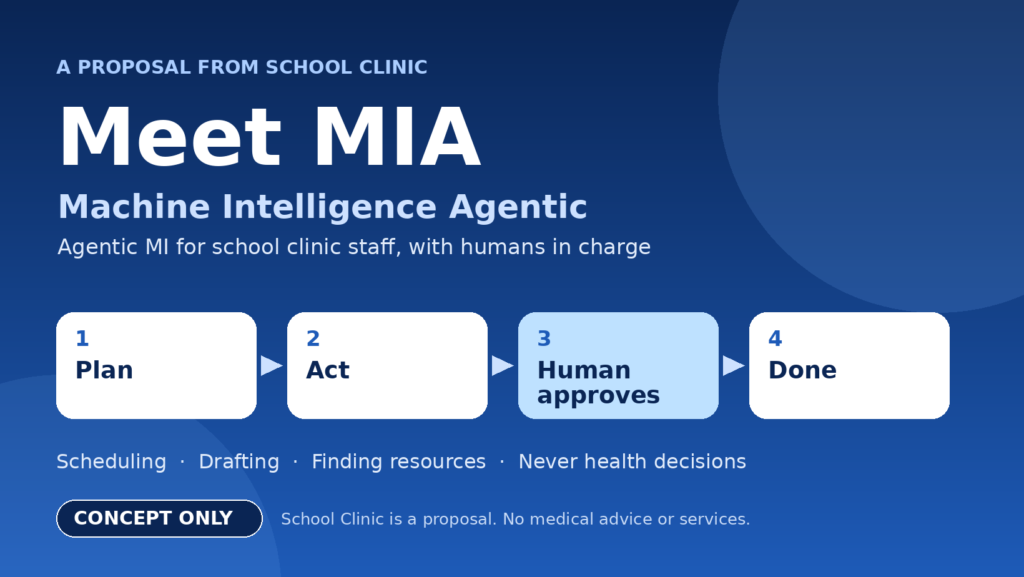
When people imagine the future of school health, they often look to hospitals and clinics. Japan offers a different picture. In Japanese schools, health care begins with an educator: the yogo teacher (yōgo kyōyu, 養護教諭), who runs the school health room and looks after students’ bodies and minds. In this post, we ask whether the yogo model could guide how we design MIA, our proposed name for Machine Intelligence Agentic.
Reminder: School Clinic is a proposal. The clinic does not yet exist, and School Clinic offers no medical advice or services whatsoever. Everything below is a vision for discussion, not a product or a service.
Who yogo teachers are
According to Japan’s Ministry of Education (MEXT), “A yogo teacher is a teaching staff, who plays a pivotal role to promote school health activities.” Kanako Okada of Chiba University describes yogo teachers as “special licensed educators who support children’s growth and development through health education and health services,” and notes that most Japanese schools have one or more yogo teachers “instead of school nurses.”
As Nippon.com explains, Japan once had school nurses much like those in the West, but in Japan the role became part of the teaching staff. Yogo teachers train for the position, usually at university, and earn a teaching license. A nursing license is not required.
The health room: a safe place for every student
MEXT says each school in Japan has a school health room, the hokenshitsu, “for health checks, health counseling and guidance, and first aid,” and that “all students can use this room at any time.” Yogo teachers manage that room. Their work, as MEXT describes it, includes first aid, health checks, daily health observation, infection prevention, school hygiene, health counseling and guidance, and teaching.
The health room is about more than scraped knees. Nippon.com reports that on a busy day, as many as 60 children might visit the yogo teacher at a school of more than 500 students. For some students who struggle with the classroom, the health room becomes the place where they can still come to school. Japan even has a word for it: hokenshitsu tōkō, attending school by spending time in the health room.
A team, not a lone hero
Yogo teachers do not work alone. MEXT notes that Japanese schools are required to have a school doctor, a school dentist, and a school pharmacist. Class teachers do daily health observation, and schools work with public health centers, child guidance centers, and others. MEXT also makes a point worth remembering: “a school is not a medical institution but educational one,” so first aid at school is “a temporary measure.”
Five lessons for designing MIA
To be clear, we are not proposing an MI yogo teacher. A yogo teacher’s warmth, judgment, and daily presence in a child’s life cannot be replaced by a machine. What we propose is that the yogo model, the values behind the role, could shape how MIA is designed to support the adults in a school clinic.
- Education first, not medicine. The yogo role sits inside education, and MEXT reminds us that a school is not a medical institution. MIA should follow the same line: help staff with general health education materials, schedules, and paperwork, and never diagnose, triage, or give medical advice.
- Body and mind together. Yogo teachers care for physical and emotional well-being at once. MIA should help staff see the whole picture, for example by keeping resource lists for counseling, food, and family support up to date, while leaving every judgment to people.
- Protect the safe room. The health room works because students trust a person there. MIA should free up that person’s time, not stand between them and a student. In School Clinic’s vision, MIA works for adult staff only and never communicates with anyone under 18.
- Coordinate the team. Yogo teachers connect class teachers, school doctors, dentists, pharmacists, parents, and community agencies. Coordination is exactly where agentic MI could help: scheduling health checks, tracking follow-ups, and drafting notices, all approved by a human. Our list of 101 ways an MI assistant could help social workers shows how much of this behind-the-scenes work exists.
- Value the people. Nippon.com notes that yogo teachers “are not sufficiently appreciated in Japan.” American school nurses face their own shortage, as we wrote in Too Few School Nurses, Too Much Paperwork. MIA should be used to give these professionals more time and recognition, never as a reason to cut their jobs.
The MIA guardrails still apply
- MIA supports adult staff and never contacts students under 18.
- MIA makes no health decisions and gives no medical advice.
- Humans approve every action, and every step is logged.
- Privacy comes first, under laws such as FERPA and HIPAA. See FERPA and HIPAA, Explained Simply.
- In an emergency or crisis, MIA stops and hands off to people right away.
Learning across borders
School health looks different in every country, and no single model fits everywhere. But the yogo teacher reminds us that school health can be built around education, trust, and a safe place to go, and that technology should strengthen those things, not replace them. We have also looked at nearly 40 years of school-based health centers in the United States. Together, these traditions give MIA a lot to learn from.
Tell us what you think
Have you worked as, or with, a yogo teacher? What should Americans understand about the role? Which parts of the yogo model could inspire school health in the US, and which should stay uniquely human?
We invite college students, parents, school nurses, doctors, social workers, physician assistants (PAs), pharmacists, dietitians, physical therapists, educators, researchers, policymakers, and members of the public to participate.
Get involved or email mail@school.clinic. School Clinic does not communicate with anyone under 18.
Sources: Ministry of Education, Culture, Sports, Science and Technology (MEXT), “School Health Activities” (reference material, 2024); Kanako Okada, “The Yogo Teacher, the Health Room, and Health Education at School in Japan,” in Asian Perspectives and Evidence on Health Promotion and Education (Springer, 2011); Akiyama Chika, “A View from the School Health Center: Supporting Japanese Children’s Physical and Mental Well-Being,” Nippon.com, April 10, 2018.
School Clinic is a proposal and offers no medical advice or services whatsoever. This post describes a possible future for discussion only. MIA is a proposed name, not a product or service, and is not affiliated with any Japanese organization. The featured image is a concept image only. School Clinic does not communicate with anyone under 18. In an emergency, call 911. In a mental health crisis, call or text 988.

